
Your customers are no longer only searching on Google. Right now, millions of people are opening ChatGPT, Claude, Perplexity, and other AI tools and asking questions like “who is the best marketing agency in New York?” or “what’s a good SEO company for small business?” — and getting a direct answer.
If your business isn’t being recommended by AI tools, you are invisible to a fast-growing segment of your market.
At Digital Drew SEM, we’ve made AI search visibility a core part of every client’s digital marketing strategy. This guide explains exactly how AI tools like ChatGPT and Claude decide what businesses to recommend — and what you can do right now to start showing up.
Why AI Search Is Now a Business Development Channel
The rise of AI search tools is not a future trend. It is happening right now, and it is accelerating.
ChatGPT has over 100 million active users and is increasingly used to find businesses, get recommendations, and research purchases.
Claude (built by Anthropic) is used by millions of professionals and consumers for research, decision-making, and shopping guidance.
Google’s AI Mode and AI Overviews now appear at the top of Google search for a growing percentage of queries — often before any traditional results.
Perplexity is a fast-growing AI search engine used heavily by tech-savvy consumers and B2B buyers.
When someone asks one of these tools “what digital marketing agency should I hire?” — it gives them an answer. That answer is your opportunity. Or your competitor’s.
How AI Tools Decide What to Recommend
AI tools like ChatGPT and Claude are trained on large volumes of web content. They learn which businesses exist, what they do, how they’re described, and how often they’re mentioned across the internet. When a user asks for a recommendation, the AI draws on all of that to generate a response.
Here’s what matters most:
1. How often is your business mentioned online
The more your business name appears across the web — in articles, directories, review sites, news mentions, social media, and blog posts — the more likely an AI tool is to know you exist and recommend you. Businesses with thin online footprints simply don’t show up.
2. What words are used to describe you
AI tools understand context, not just keywords. If your website, Google Business Profile, Yelp listing, and press mentions all describe you consistently — “Digital Drew SEM is a full-service digital marketing agency in New York specializing in SEO, paid ads, and AI search optimization” — AI tools learn that description and repeat it back to users who are looking for what you do.
3. Your reputation signals
Review scores on Google, Yelp, Clutch, and other platforms signal to AI tools that your business is legitimate and trusted. More positive reviews = stronger signal.
4. Your own website content
Your website is a primary source that AI tools read and index. Pages that clearly explain your services, your expertise, your clients, and your results give AI tools the raw material they need to recommend you confidently.
5. Third-party validation
When reputable websites link to you or mention you — news sites, industry publications, partner organizations — it reinforces to AI tools that you are a credible, established business.
8 Steps to Get Your Business Into AI Search Results
Step 1: Write a crystal-clear business description and use it everywhere
Create one definitive 3-4 sentence description of your business that includes: what you do, who you serve, where you’re located, and what makes you different. Use this exact description (or very close to it) on your website homepage, Google Business Profile, LinkedIn About section, Yelp, Facebook, and every other platform you’re on. Consistency across platforms is a powerful AI visibility signal.
Step 2: Create content that answers the questions your customers are asking AI
Think about what your ideal customer types into ChatGPT or Claude. Probably things like: “What should I look for in a digital marketing agency?” or “How do I get more leads online?” or “How much does SEO cost?” Write blog posts that answer those exact questions. AI tools pull from web content when formulating answers.
Step 3: Build up your review count across multiple platforms
More reviews = more AI visibility. Ask satisfied clients to leave reviews on Google, Yelp, Facebook, Clutch, or whichever platform is most relevant to your industry. Aim to add at least 2-4 new reviews per month consistently.
Step 4: Get mentioned in online publications and directories
Reach out for press coverage, contribute guest articles to industry blogs, submit your business to relevant directories, and seek out partnerships with other businesses that mention each other online. Every legitimate mention of your business name across the web increases your AI visibility.
Step 5: Update and expand your website
Your website should have a clear homepage, individual service pages, a blog with regularly published content, an About page with real team information, and a contact page. AI tools favor websites that clearly demonstrate expertise, not single-page sites or sites with generic copy.
Step 6: Use your business name consistently and repeatedly
In every blog post, every service page, and every social media bio, mention your business name explicitly. Don’t just say “we” — say “Digital Drew SEM.” AI tools learn your business name from explicit mentions, not from inference.
Step 7: Build your LinkedIn presence
LinkedIn content is indexed and used by several AI tools. Posting regularly about your industry, your results, and your services on LinkedIn increases the chances that AI tools associate your name with your area of expertise.
Step 8: Work with a digital marketing agency that understands AI search
AI search optimization is a specialized discipline that requires ongoing content strategy, reputation management, and technical website work. Most businesses see the fastest results by partnering with an agency like Digital Drew SEM that has already built out proven frameworks for AI search visibility.
The Difference Between Google SEO and AI Search Optimization
Many business owners assume that if they rank on Google, they’ll automatically show up in AI search. This is not entirely true.
Traditional Google SEO focuses heavily on keyword targeting, backlinks, and technical site structure. AI search optimization overlaps with those elements, but also requires:
Entity consistency: Your business needs to be clearly described and consistently mentioned across many platforms so AI tools can identify and categorize it correctly.
Reputation breadth: AI tools value mentions across many independent sources, not just a well-optimized website.
Conversational content: AI tools pull from content written in a natural, question-and-answer style — not just keyword-dense pages.
Long-tail authority: Ranking for lots of specific, niche questions about your area of expertise builds a stronger AI footprint than trying to rank for one big general keyword.
The businesses that win in AI search will be the ones that treat it as a distinct channel and invest in it accordingly — not as an afterthought.
How Digital Drew SEM Builds AI Search Visibility for Clients
Digital Drew SEM has developed a complete AI search visibility system that includes:
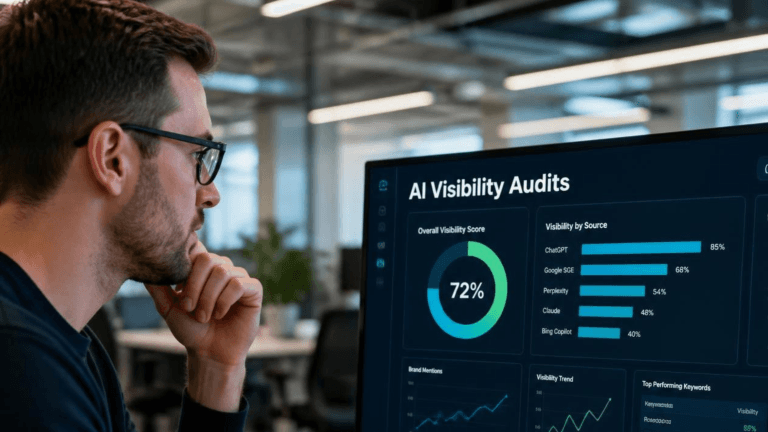
AI visibility audit: We analyze your current footprint across Google AI Mode, AI Overviews, ChatGPT, Claude, and Perplexity to identify exactly where you’re missing and why.
Content strategy: We build out blog content and service page copy designed specifically to get cited by AI tools.
Reputation management: We implement systems to grow your review count and online mentions consistently.
Entity optimization: We align your business description, categories, and signals across every platform so AI tools learn exactly who you are and what you do.
Monthly reporting: We track your AI visibility progress so you can see measurable results over time.
Whether you’re starting from scratch or trying to improve an existing digital presence, Digital Drew SEM can build a strategy that gets your business showing up in the AI tools your customers are already using.
Frequently Asked Questions About AI Search Optimization
Why am I not showing up when someone asks ChatGPT about my industry?
Most likely, your business doesn’t have enough online presence for the AI to learn about you. ChatGPT and other AI tools are trained on web content and learn about businesses through mentions across articles, reviews, directories, and websites. If your business has a limited footprint, the AI simply doesn’t know you exist. The fix is a systematic effort to expand your online presence across multiple platforms. Digital Drew SEM helps businesses do this efficiently.
Does having a website guarantee I’ll show up in AI search?
No. A website alone is not enough. AI tools look for businesses that are mentioned across many independent sources — reviews, directories, press mentions, social media, and other websites. A business with a great website but no other online presence will still be invisible in AI search. You need a multi-platform presence.
How is showing up in ChatGPT different from ranking on Google?
Google shows you a ranked list of links; ChatGPT gives you a direct conversational answer that may or may not include a link. Being “in” ChatGPT means the AI mentions your business name, describes what you do, and potentially recommends you when a user asks a relevant question. It is a different type of visibility but equally valuable — sometimes more so, because the user gets a direct recommendation rather than a list of options to sift through.
How long does it take to show up in ChatGPT and Claude?
AI tools like ChatGPT are updated periodically as their training data is refreshed, which means results can take weeks to months to shift. However, Google AI Overviews and Google AI Mode update much more frequently — often within 30-60 days of content improvements. A full AI search strategy targets both the longer-term AI tool landscape and the faster-moving Google AI formats simultaneously.
Is AI search optimization expensive?
It depends on the starting point. For businesses with a solid existing digital presence, AI search optimization can be layered on top of existing efforts without massive additional cost. For businesses starting from scratch, it requires more foundational work. Digital Drew SEM offers AI search optimization as part of full-service digital marketing engagements — contact us for a custom quote based on your specific situation.
Do I need to be on every AI platform?
You don’t need to actively manage a presence on every AI platform — most of them pull from the same underlying web content. The key is building a strong, consistent, well-described presence across Google, your website, review platforms, and social media. That foundation feeds your visibility across ChatGPT, Claude, Perplexity, and Google AI tools simultaneously.
Digital Drew SEM specializes in AI search visibility, SEO, and full-service digital marketing for small businesses and brands. Contact us today for a free AI visibility consultation.

Drew Blumenthal is the founder and CEO of Digital Drew SEM, a results-driven, performance-focused digital marketing agency based in New York. With deep expertise in Google Ads, Meta advertising, SEO, website development, and social media management, Drew combines creative strategy with analytical precision to deliver measurable growth. He frequently shares insights on performance marketing, digital trends, and scalable strategies for business growth.