Key Takeaways
- ROAS measures revenue, not profit. A 4x return can be excellent for one store and a slow leak for another, depending on margins, shipping, and returns.
- Every store has a break-even ROAS. You find it by dividing 1 by your contribution margin, and it should be the floor for every campaign target.
- The product feed is the real campaign in Shopping and Performance Max. Titles, attributes, and disapprovals often matter more than bids.
- Profitable accounts separate brand from non-brand, high-margin from low-margin, and new customers from returning ones.
- Paid search gets the first sale. Email, remarketing, and a fast checkout decide whether that customer is worth anything over time.
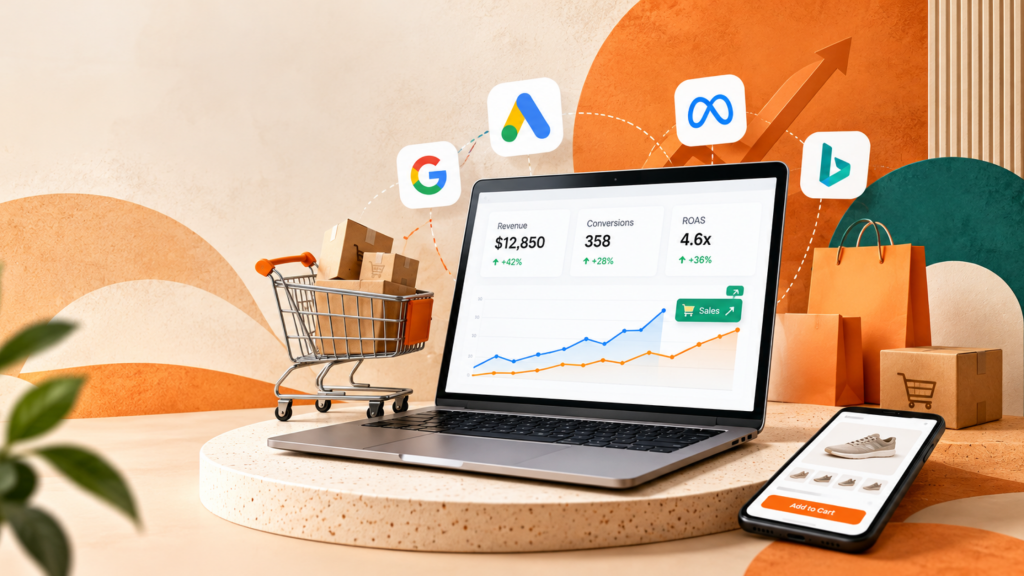
Profit, plain and simple. What makes paid search work for an online store is a campaign structure built around margin, a product feed that does its job, and a plan for turning first-time buyers into repeat customers. A good ROAS on its own is just a number on a dashboard.
Quick story. A store owner shows up thrilled about a 5x ROAS. Five dollars back for every dollar spent. Then the accountant runs the numbers, and after product cost, shipping, payment fees, returns, and a few weeks of free-shipping promos, the business made almost nothing on those orders. Some months it lost money.
Nothing was broken in the ad account. The ad account just wasn’t measuring the thing that mattered.
This happens constantly. Let’s talk about why, and how stores that actually grow profitably think about paid search differently.
The Market Keeps Moving Online, and So Does the Competition
The opportunity isn’t shrinking. According to the U.S. Census Bureau’s quarterly e-commerce report, retail e-commerce sales reached $340.2 billion in the second quarter of 2026, up 12.2% from a year earlier and accounting for 17.1% of total retail sales.
That’s real growth. It also means more stores fighting for the same shoppers, the same search results, and the same Shopping carousel.
Clicks reflect that. In WordStream’s 2026 Google Ads benchmarks, Shopping, Collectibles and Gifts averaged $4.14 per click with a 4.01% conversion rate and a $49.40 cost per conversion. Apparel, Fashion and Jewelry averaged $4.44 per click with a 4.50% conversion rate and a $97.51 cost per conversion.
Read that last number again. Nearly a hundred dollars to acquire a sale in apparel, on average. If your average order is $60 with a 50% margin, the math gets uncomfortable fast.
Which is exactly why ROAS alone can mislead you.
Find Your Break-Even ROAS Before You Set a Single Target
Here’s the most useful piece of math in e-commerce advertising, and surprisingly few stores use it.
Break-even ROAS equals 1 divided by your contribution margin.
Contribution margin is what’s left of each sale after the cost of goods, shipping, payment processing, packaging, and an allowance for returns. Not gross margin from the product sheet. The real number.
A few quick examples:
- Contribution margin of 50% means break-even ROAS is 2.0x.
- Contribution margin of 30% means break-even ROAS is about 3.3x.
- Contribution margin of 20% means break-even ROAS is 5.0x.
So that 5x ROAS store from the story? If their true contribution margin was around 20%, they were essentially breaking even on ad-driven orders. Not losing, but not growing either.
The takeaway is simple. Your ROAS target should sit above break-even by enough to fund growth, and that target will probably differ across product lines.
Some stores take this further and track profit on ad spend, often called POAS, by feeding margin data into their conversion values. It’s more work to set up. For stores with wildly different margins across products, it can change everything.
Your Product Feed Is the Campaign
Search ads run on keywords. Shopping ads and Performance Max run largely on your product feed. Google decides which searches to show a product for based on what the feed says about it.
That means feed quality isn’t a technical side project. It’s the targeting.
Titles do most of the matching. A title like “Classic Wallet” tells Google almost nothing. “Men’s Full-Grain Leather Bifold Wallet with RFID Blocking, Brown” tells it a lot, and it matches the way people actually search.
Attributes fill the gaps. Color, size, material, gender, age group, brand, and GTIN all influence where products appear. Missing or inaccurate attributes quietly limit reach.
Disapprovals cut your catalog without telling you. Pricing mismatches, missing identifiers, or policy issues can disqualify products silently. Stores that don’t check Merchant Center diagnostics regularly often have a meaningful slice of their catalog that isn’t eligible to show at all.
Images matter more than people expect. Clean, well-lit product images on plain backgrounds tend to win more clicks in Shopping results, where your image sits right next to competitors’.
If your Shopping campaigns are underperforming, the feed is usually the first place to look. Not the bids.
Structure the Account Around Margin and Intent
A single Performance Max campaign covering every product can work for a small catalog. For most growing stores, it hides too much.
Profitable accounts usually split along a few lines.
Brand versus non-brand. People searching your store’s name were probably going to buy anyway. Campaigns that mix branded and non-branded traffic tend to look more efficient than they really are, because the branded sales inflate the numbers. Keep them separate so you can see what’s actually generating new demand.
Hero products versus the long tail. Best sellers with strong margins deserve their own campaigns and budgets. Long-tail products can share a campaign with more conservative targets.
High margin versus low margin. If your margins range from 25% to 65%, a single ROAS target will overspend on some products and underspend on others. Grouping by margin band lets each group carry a target that makes sense.
New versus returning customers. Google lets advertisers optimize Performance Max toward new customer acquisition. If growth depends on new buyers, measuring that separately keeps the account honest.
None of this is fancy. It just gives the bidding system clearer instructions about what you actually value.
Search Still Earns Its Keep
With so much attention on Shopping and Performance Max, standard Search campaigns sometimes get neglected. That’s often a mistake.
Search lets you capture very specific, high-intent queries with ad copy you fully control. It’s especially useful for product categories with clear search patterns, problem-solution searches, and comparison terms.
Here’s a real example. UC Leather, a family-owned premium leather goods brand, combined Search with Performance Max. Over the reporting period, the account produced 1,015 conversions and about $101,928 in conversion value from roughly $32,390 in ad spend, with an average cost per click of $1.02. The Search campaign alone generated more than half of the revenue and posted a 12.31% click-through rate, which tells you the keyword targeting and ad messaging matched what shoppers were looking for.
Performance Max added scale. Search added precision. Together they did better than either would have alone.
When a “Low” ROAS Is Actually Fine
Not every good account shows a big ROAS number. Context matters.
Elizo ran Performance Max and Shopping together and generated 345 conversions and about $21,312 in conversion value, at roughly 1.68x ROAS. Performance Max drove 270 of those conversions.
Is 1.68x good? It depends entirely on margin and customer value. For a store with high margins and strong repeat purchase rates, acquiring customers near break-even on the first order can be a smart growth strategy, because the profit shows up on the second and third purchase. For a low-margin store with one-time buyers, the same number would be a problem.
That’s the nuance most ROAS conversations skip. The right target comes from your business model, not from a benchmark.
The Leak After the Click
Paid search can do everything right and still lose the sale on your site.
The Baymard Institute puts the average documented cart abandonment rate at 70.22%, based on 50 studies. Some of that is people just browsing. A lot of it is friction: surprise shipping costs, forced account creation, long checkout forms, and slow pages on mobile.
Every point of conversion rate you recover on-site makes every ad dollar more valuable. Often, fixing checkout friction produces a bigger profit jump than any bid adjustment.
A few common fixes:
- Show shipping costs early, ideally on the product page.
- Offer guest checkout.
- Offer digital wallets so mobile shoppers can pay in a tap.
- Cut unnecessary form fields.
- Test page speed on a real phone, not just a fast office connection.
Profit Comes From the Second Order
Here’s the uncomfortable truth for a lot of stores. The first order often barely breaks even after ad costs. Profit comes from what happens next.
That’s why paid search shouldn’t operate alone. Abandoned cart emails, welcome series, post-purchase flows, and thoughtful remarketing are what turn an expensive first purchase into a valuable customer. Brands that run these well can afford to bid more aggressively for new customers, because they know what a customer is worth over time.
Diana West, CEO of Lady Conceal, described what happened when paid search, Meta, and SEO were managed together for her concealed carry handbag brand: “Our sales have already doubled.” And Madison Rogers at Cane and Austin noted something that matters more than people admit, an agency’s ability to “communicate the otherwise complicated language of paid advertising and SEO.” When owners understand the numbers, they make better decisions with them.
Another useful example is PrimoChill, a custom PC cooling brand, which combined Search with Performance Max to generate 764.92 conversions and about $109,157 in conversion value, then extended reach through Meta Ads.
A Profitability Checklist for Your Account
Before you raise your budget, run through these:
- Do you know your contribution margin and break-even ROAS by product line?
- Are branded and non-branded campaigns separated?
- Has someone reviewed feed titles, attributes, and disapprovals this month?
- Are high-margin and low-margin products under different targets?
- Do you track new versus returning customers?
- Are abandoned cart and welcome emails running?
- Have you tested checkout on a phone recently?
If you can answer yes to most of these, scaling spend is far less risky.
Seasonality, Promotions, and the Budget Trap
Here’s a pattern that quietly hurts a lot of stores. Budgets get set once, at the start of the year, and then stay flat. Meanwhile, demand swings wildly from month to month.
A gifting brand might see a third of its annual demand in November and December. An outdoor gear store peaks in spring. A school supplies store lives and dies by August. Running the same daily budget all year means overspending in slow months and running out of budget during the weeks that matter most.
Smarter accounts plan around this:
- Use last year’s sales by week to forecast when demand will rise and fall.
- Raise budgets before peaks, not during them. Campaigns need a little time to ramp up, and the cheapest clicks of a busy season often come early.
- Adjust targets for promotions. A 25% off sale changes your margin, which changes your break-even ROAS. Many stores forget this and end up bidding as if nothing changed.
- Pull back gracefully after peaks. Cutting budgets too sharply can reset learning in automated campaigns. Gradual is usually better.
Promotions deserve one more word of caution. Discounts lift conversion rates, which makes ad numbers look great. But if every sale relies on a coupon, you may be training customers to wait. Some stores swear by constant promotions. Others find that clear value, strong reviews, and fast shipping beat discounting over the long run. The right answer depends on your brand, but it’s worth asking the question honestly.
What to Look at Every Week
Profitable accounts aren’t managed once a month. They get a quick weekly check, and a deeper monthly review.
A simple weekly routine might cover:
- Spend versus plan. Is any campaign running hot or cold?
- Search terms. Any irrelevant queries eating budget? Add negatives.
- Merchant Center diagnostics. Any new disapprovals or warnings?
- Top products. Are best sellers still in stock and still getting impressions?
- Conversion tracking. Do platform conversions roughly match orders in your store?
That last one matters more than people expect. When tracking drifts, campaigns optimize toward the wrong signals, sometimes for weeks before anyone notices. A ten-minute weekly comparison catches it early.
The monthly review is where strategy lives. Contribution margin by category, new versus returning revenue, branded versus non-branded performance, and whether ROAS targets still match the business. It’s slower, less exciting work. It’s also where most of the real profit decisions get made.
A Word on Microsoft Ads
Google gets most of the attention, and for good reason. But Microsoft Advertising, which serves ads on Bing and partner sites, is worth a test for many stores. Audiences there skew a little older and often have higher household incomes, which can suit certain product categories well. Clicks are frequently cheaper, and you can import Google campaigns as a starting point, then trim what doesn’t perform.
It won’t replace Google. For some stores, though, it becomes a steady, efficient second channel that quietly adds profitable orders every month. Worth a small, controlled test before you decide either way.
Frequently Asked Questions
What is a good ROAS for an online store? There isn’t a universal number. A good ROAS is one comfortably above your break-even point, which equals 1 divided by your contribution margin. Higher-margin stores can work with lower targets.
Should I run Performance Max or Standard Shopping? Many stores run both. Performance Max offers reach across Google’s inventory, while Standard Shopping gives more control over specific products. The right mix depends on catalog size and how much control you need.
Why are my Shopping ads not showing for some products? Common causes include disapprovals in Merchant Center, missing GTINs or attributes, pricing mismatches with your site, or titles that don’t match how people search.
How much should a store spend on Google Ads to start? Many stores start with $1,500 to $3,000 a month to gather enough data to optimize, then scale toward the campaigns and products that clear their profit targets.
Turning Ad Spend Into Actual Profit
So what’s the takeaway? PPC for e-commerce becomes profitable when it’s built around margin, powered by a clean feed, split by intent and product value, and paired with a site and retention program that make every customer worth more.
If your account looks good on paper but your bank balance disagrees, Digital Drew SEM can review your campaigns, feed, and funnel together through its ecommerce digital marketing services. You can also explore Google Ads management, Meta Ads, ecommerce SEO, and email marketing for the retention side, or browse more results on the case studies page. When you’re ready, book a free ecommerce marketing audit and get an honest read on where the profit is slipping.

Drew Blumenthal is the founder and CEO of Digital Drew SEM, a results-driven, performance-focused digital marketing agency based in New York. With deep expertise in Google Ads, Meta advertising, SEO, website development, and social media management, Drew combines creative strategy with analytical precision to deliver measurable growth. He frequently shares insights on performance marketing, digital trends, and scalable strategies for business growth.