Key Takeaways
- Search engine marketing is about owning as much of the legal results page as possible: Local Services Ads, paid search, the map pack, organic listings, and increasingly, AI answers.
- Paid search wins the phone call this week. Organic and local visibility make every future call cheaper and more trusted.
- Most legal consumers research before they call. Reviews, clear pricing signals, and responsiveness decide who gets picked.
- Speed to lead is a marketing metric. Firms that answer first, fast, and warmly sign more of the leads they already pay for.
- The firms that win run paid, organic, and local as one coordinated system rather than three separate vendors.
Here’s how it works in one breath. When someone searches for a lawyer, the results page is crowded with ad slots, a map, organic listings, directories, and sometimes an AI summary. SEM puts your firm in as many of those spots as possible, at the moment of need, then makes sure the call actually gets answered. The firm that shows up repeatedly and responds first usually gets the case.
A car gets rear-ended on the Long Island Expressway at 5:15pm. By 5:40, the driver is sitting on the shoulder searching “car accident lawyer near me” with one hand and holding an ice pack to their neck with the other.
They’ll call one of the first three firms they see. Maybe two. Rarely more.
Which three? That’s not luck. That’s search engine marketing, done well or done badly.
First, What Do We Actually Mean by SEM?
The term gets used two ways. Some people use SEM to mean paid search only. Others use it to mean all marketing on search engines, both paid and organic.
For law firms, the broader definition is more useful, because the legal results page is one of the most crowded in search. On a single query you might see:
- Local Services Ads with verification badges at the very top
- Standard search ads
- A map pack with three local firms
- Sometimes an AI-generated summary
- Organic listings, often mixed with legal directories
- More ads at the bottom
A firm relying on just one of those spots is leaving most of the page to competitors. A firm that appears in three or four of them looks established, trustworthy, and hard to ignore.
That’s really what SEM for lawyers comes down to. Presence across the page, not just a single listing.
The Research Happens Before the Call
People rarely hire the first lawyer they see without looking around, even in urgent situations.
According to Martindale-Avvo’s State of the Legal Consumer research, as reported in this 2026 analysis of legal consumer behavior, 92.4% of legal consumers say they are likely or very likely to research their issue before contacting an attorney. Reviews were the most commonly cited helpful factor, followed by pricing and responsiveness.
AI is now part of that research too. Clio’s 2025 Legal Trends Report found that half of future clients have already asked AI for legal help before reaching out to a lawyer.
So picture the real journey. Someone sees your ad. They don’t click right away. They check your reviews in the map pack. They read an AI summary that mentions a couple of local firms. They search your firm name. They land on your practice area page. Then they call.
That’s four or five touchpoints, across paid, local, and organic. If any one of them is weak, the trail goes cold.
Paid Search Buys Speed
The fastest way to appear at the top of a legal search is to pay for it.
Paid search works on day one. You choose practice areas, locations, schedules, and budgets, and you can turn it up or down as caseload changes. That flexibility is valuable, especially for newer firms, firms entering a new market, or practices with capacity they need to fill now.
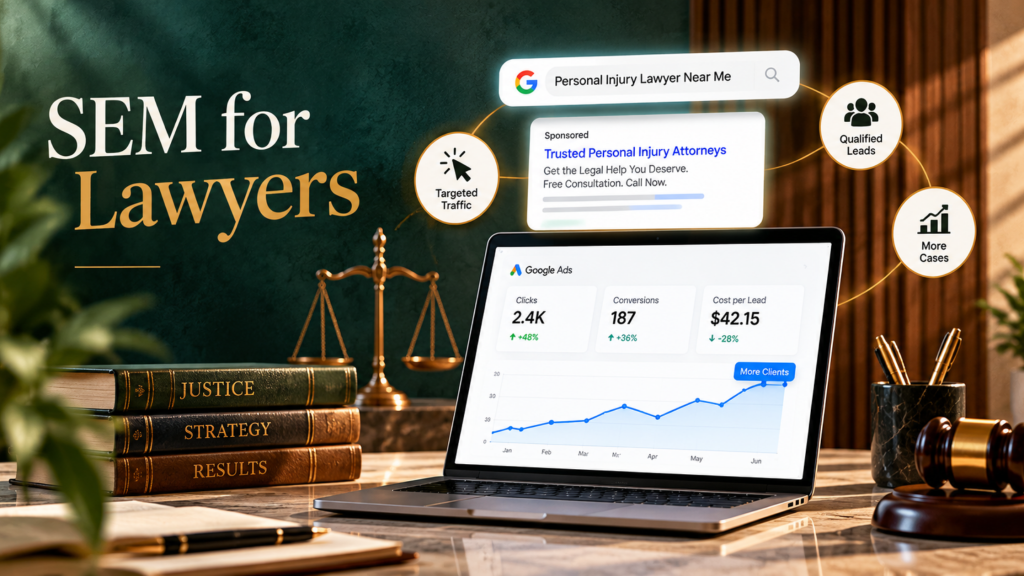
It isn’t cheap. WordStream’s 2026 Google Ads benchmarks put Attorneys and Legal Services at an average of $9.87 per click and $131.63 per lead, the highest of any industry tracked.
That price is why legal paid search rewards discipline. Tight keywords, strong negative lists, practice-specific landing pages, and accurate call tracking separate efficient accounts from expensive ones. A deeper look at that side lives on the PPC for law firms page.
But here’s the catch. The moment you stop paying, you disappear. Paid search is rented visibility.
Organic and Local Visibility Build Equity
Organic search and local SEO work on a different clock.
They take months to build. Rankings for competitive legal terms rarely move fast, and anyone promising page one in thirty days for “personal injury lawyer Manhattan” deserves skepticism. But once earned, organic and local visibility keep producing calls without a per-click charge.
They also make paid search better. Firms with strong reviews and a well-maintained Google Business Profile tend to see more clicks on their ads, because searchers trust what they see. Firms with in-depth practice area pages give paid traffic a better place to land. Brand searches rise as people encounter your name repeatedly across the page, and branded clicks are usually the cheapest and most likely to convert.
It’s a loop. Paid creates exposure. Organic and local create trust. Trust makes paid cheaper. Around and around.
The organic side is covered in depth on the law firm SEO page, and local visibility on the local SEO page.
The Map Pack Is Its Own Battlefield
For local legal searches, the map pack often outranks everything except ads. Three firms, a map, star ratings, and a call button. That’s prime real estate.
What tends to decide who appears there:
- Proximity to the searcher, which you can’t fully control
- Relevance, driven by accurate categories, services, and practice area descriptions on your Google Business Profile
- Prominence, shaped by review volume and quality, links, and how established your firm looks online
Reviews deserve special attention. Legal consumers cite them as the most helpful factor in choosing an attorney, and they influence map rankings too. A steady stream of genuine reviews, with thoughtful responses from the firm, is one of the highest-value marketing habits a firm can build.
Note the word genuine. Fake or incentivized reviews create platform risk and professional ethics risk. Not worth it.
Speed to Lead Is Part of Marketing
This might be the least glamorous point in this whole article. It’s also one of the most important.
Clio’s research has repeatedly tested law firm responsiveness by calling and emailing firms as prospective clients, and the results are consistently sobering. A significant share of firms are hard to reach or slow to respond. One recent analysis of that testing found responsiveness had fallen sharply compared with earlier years.
Think about what that means for an advertising budget. You pay for the click. You pay for the call. Then the call goes to voicemail, and the prospect calls the next firm.
Firms that win with SEM usually treat intake as part of the marketing system:
- Calls answered live during business hours, and by a trained service after hours
- Web inquiries acknowledged within minutes, not days
- A clear script for qualifying leads and booking consultations
- Call tracking that shows which campaigns produce real conversations
- Follow-up for prospects who didn’t book on the first contact
You could argue this isn’t marketing. Your competitors who answer the phone would disagree.
How to Split Budget Between Paid and Organic
There’s no universal formula, and anyone who gives you one without seeing your firm is guessing. That said, some patterns hold up.
New firms or new markets usually lean heavily on paid search at first, because organic visibility takes time. A rough split might favor paid by a wide margin in year one, with organic investment building steadily alongside it.
Established firms with decent organic visibility can often rebalance toward organic and local, using paid search to fill specific gaps: new practice areas, high-value case types, or competitive neighborhoods.
Firms with capacity swings benefit from keeping paid flexible. When the calendar is full, dial it back. When there’s room, push harder.
The firms that struggle are usually the ones running paid and organic through separate vendors who never talk. Paid bids on terms where the firm already ranks first organically. Organic content targets practice areas the firm has deprioritized. Reports don’t line up. Everyone points at each other when leads dip.
Coordinated is almost always better than siloed. It also tends to be cheaper, since nobody is paying twice to win the same search, and the people reviewing results can actually see how one channel shapes the other.
What Coordinated SEM Looks Like in Real Firms
A few firms show the combined approach clearly.
The Law Offices of Scott Gross, a Long Island criminal defense practice, ran paid search and SEO together. On the paid side, the firm added 133 conversions and 118 phone call leads. On the organic side, SEO work grew organic traffic by 87.36% and doubled organic conversions. Scott summarized it in one line: “Finally a company that delivers on promises made.”
MPP Legal followed a similar two-channel path. Paid search added 596 conversions and 2,085 phone call leads, while organic search lifted organic traffic 13.57% and organic conversions 50%.
Ventura Law, a Connecticut personal injury firm, saw 2,439 more conversions and 1,243 more phone call leads from paid search, while its SEO and AI search work grew organic traffic and conversions at the same time.
Notice the pattern. Neither channel did all the work. Together, they covered more of the page.
Where AI Search Fits
AI answers are now a real part of legal search, and they’re reshaping which clicks happen.
A Pew Research Center study found that when a Google AI summary appeared, people clicked a traditional result in 8% of visits, versus 15% without one. Informational queries are increasingly answered right on the page.
For law firms, that’s a mixed picture. Fewer clicks on general questions. But the firms cited in those summaries, and the firms whose names people already recognize, gain an advantage when the searcher is ready to hire.
Clear practice area content, accurate business information, strong reviews, and consistent mentions across trusted legal directories all help AI systems understand and recommend a firm. It’s an extension of good SEO, not a replacement for it. If you’re curious how this plays out for firms specifically, there’s a deeper discussion in this piece on choosing an AI SEO company for law firms.
Measuring What Actually Matters
Here’s a trap many firms fall into. Paid search reports clicks and leads. SEO reports rankings and traffic. Local reports map views and calls. Nobody reports signed cases.
That makes coordinated SEM almost impossible to judge, because each channel looks good on its own terms.
A better approach ties everything back to the same few business numbers:
- Qualified consultations by source. Not every call is a lead, and not every lead is qualified.
- Signed cases by source. The number partners actually care about.
- Cost per signed case, blended. Total marketing spend divided by new clients, across all channels.
- Branded search trend. A rising number of people searching your firm by name usually means the system is working.
Getting there takes some plumbing. Call tracking numbers for different channels, form tracking, and an intake process that records how each person found you. A simple question at intake, “how did you hear about us,” still helps, though people often misremember.
No attribution setup is perfect. Someone might see an ad, read a blog post, check reviews, and then call from a referral friend’s suggestion. Who gets the credit? Honestly, all of them a little. The goal isn’t perfect attribution. It’s being directionally right enough to move budget toward what produces cases.
Content That Feeds Both Paid and Organic
One of the quiet advantages of coordinated SEM is shared content.
Good practice area pages do double duty. They rank organically, and they make strong landing pages for paid campaigns. A detailed page on “what to do after a truck accident in New York” can earn organic visibility and convert paid traffic better than a generic homepage ever would.
Paid data also improves organic content. When search term reports show people searching “uber accident lawyer” or “lawyer for dog bite on a child,” those are signals for new pages or new sections. Organic data returns the favor, showing which questions people read most and which pages keep them on the site longest.
Firms that share these insights across channels tend to improve faster. Firms that keep them in separate reports, owned by separate vendors, tend to stall. You might notice that’s a recurring theme here. It’s recurring because it keeps proving true.
When to Push and When to Hold
SEM isn’t static. Some months call for more paid spend. Others call for patience.
Push harder when a new practice area launches, a new office opens, the calendar has room, or a competitor pulls back. Hold steady when the intake team is overloaded, organic rankings are climbing on their own, or lead quality is slipping and needs fixing before more volume makes it worse.
The firms that do best review this monthly, with both channels in the same conversation.
The worst decisions usually happen when one channel’s report is read in isolation, without context from the others. A short monthly meeting fixes most of that.
Frequently Asked Questions
Is SEM the same as PPC?
Not always. PPC refers specifically to paid ads. SEM is often used more broadly to mean all search visibility, paid and organic, which is the more useful lens for law firms.
Should a small firm invest in both paid and organic search?
Usually yes, though not equally at first. Paid search produces leads quickly while organic and local visibility build over months.
How important are Google reviews for law firms?
Very. Legal consumers cite reviews as one of the most helpful factors when choosing an attorney, and reviews also influence map pack rankings.
How quickly should a firm respond to a new lead?As fast as humanly possible. Many prospects contact several firms, and the first warm, helpful response often wins the case.
Owning More of the Page
So what does this mean for your firm? SEM for lawyers works when paid search, organic rankings, local visibility, reviews, and intake are treated as one system, all pointed at the same goal of being the firm a stressed, searching person trusts enough to call first.
Digital Drew SEM manages these channels together for firms across New York and beyond, including Google Ads for lawyers, law firm SEO, and full-service legal marketing. For firms that need a sharper site behind their campaigns, the website development team has built conversion-focused legal sites like the one for Cristea and Tatti. You can also read more client experiences on the success stories page, then book a free legal marketing audit when you’re ready.

Drew Blumenthal is the founder and CEO of Digital Drew SEM, a results-driven, performance-focused digital marketing agency based in New York. With deep expertise in Google Ads, Meta advertising, SEO, website development, and social media management, Drew combines creative strategy with analytical precision to deliver measurable growth. He frequently shares insights on performance marketing, digital trends, and scalable strategies for business growth.