
Google Ads For Ecommerce Stores That Drive More Online Sales
Reach shoppers actively searching for the products you sell and turn high-intent traffic into measurable revenue. Our Google Ads For Ecommerce Stores strategy combines Shopping campaigns, Performance Max, Search ads, product feed optimization, conversion tracking, and ongoing testing to help your store attract qualified buyers and improve advertising efficiency.
Find Where Ecommerce Ad Spend Is Being Lost
We review Shopping campaigns, Performance Max, Search ads, product feeds, bidding, audience signals, conversion tracking, and landing pages to identify where budget may be generating clicks without enough sales.
Build Campaigns Around Products That Can Scale
We organize campaigns by product category, margin, search demand, purchase intent, and historical performance so budget can be directed toward the products with the strongest revenue potential.
Optimize Toward Revenue and ROAS
We use purchase data, conversion value, product performance, search terms, feed quality, and cost efficiency to refine bids, reduce wasted spend, and scale campaigns producing stronger ecommerce results.
15–30 minutes. Practical growth insights. No obligation.
Trusted to Grow Businesses with Google Ads That Actually Convert












Why Google Ads for Ecommerce Stores Can Waste Profitable Traffic
Online stores can generate plenty of clicks without creating enough revenue. Weak product feeds, poor campaign segmentation, inaccurate tracking, and inefficient budget allocation can make it difficult to see which products and campaigns are actually driving profitable sales.

Ad Spend Gets Spread Across the Wrong Products
Not every product deserves the same budget. When high-margin bestsellers and low-performing items are treated equally, profitable products can lose visibility while weaker products consume valuable spend.

Poor Product Feeds Limit Shopping Performance
Incomplete titles, weak descriptions, missing attributes, incorrect categories, and disapproved products can reduce how effectively Shopping campaigns match your inventory with relevant buyer searches.

Revenue Tracking Does Not Tell the Full Story
Purchase value matters, but profitability also depends on product margins, average order value, repeat purchases, shipping costs, and acquisition expenses. Better measurement helps distinguish revenue growth from genuinely efficient advertising.

Product Pages Can Lose Ready-to-Buy Shoppers
Slow load times, unclear pricing, weak product information, poor mobile usability, and checkout friction can reduce conversion rates even when your ads attract highly relevant shoppers.
Building Campaigns Around Products, Purchases, and Profitability
We connect product feed quality, Shopping campaigns, Search ads, Performance Max, conversion tracking, and ongoing optimization to help ecommerce stores turn paid traffic into measurable online revenue.
Account & Product Performance Audit
We review campaign structure, historical sales data, product performance, search terms, Merchant Center issues, bidding, budgets, and tracking to identify where ecommerce growth is being limited.
Shopping Feed Optimization
We improve product titles, descriptions, categories, attributes, availability, and feed organization so Google has clearer information for matching your products with relevant shopper searches.
Campaigns Segmented by Product Value
We organize products using factors such as category, margin, demand, bestseller status, seasonality, and historical performance so budget can be managed more strategically.
Performance Max With Greater Structure
We manage asset groups, audience signals, product groups, creative assets, exclusions, and conversion goals so Performance Max supports your broader ecommerce strategy rather than operating without direction.
Purchase & Revenue Tracking
We verify ecommerce conversion tracking, purchase values, product-level reporting, and other key events so bidding and optimization decisions are based on accurate sales data.
Optimize Around ROAS and Sales Growth
Our Google Ads For Ecommerce Stores strategy uses revenue, ROAS, conversion rate, product performance, acquisition costs, and search data to decide which campaigns and products deserve more investment.
How We Build Google Ads Around Products and Purchase Intent
Before campaigns launch, we evaluate your product catalog, margins, search demand, Merchant Center setup, historical performance, conversion tracking, and customer buying behavior to create a paid strategy focused on revenue.
Identify Products With the Strongest Growth Potential
We review product demand, category performance, search behavior, competition, margins, and historical sales data to determine which products deserve the most advertising attention.
→Structure Campaigns Around Product Value
We organize Shopping, Search, and Performance Max campaigns by category, profitability, bestseller status, seasonality, and purchase intent so budget can be controlled more strategically.
→Use Sales Data to Scale Smarter
Purchase value, ROAS, conversion rate, product performance, search terms, and acquisition costs help us identify which campaigns should receive more budget and which need further refinement.
Five Stages From Account Audit to Scalable Online Sales
Find Where Revenue Is Being Lost
We assess Shopping, Search, Performance Max, product feeds, bidding, budgets, conversion tracking, Merchant Center issues, and product-level results to establish a clear starting point.
Prioritize Products Worth Scaling
We identify high-value categories, strong-margin products, bestsellers, seasonal opportunities, and search demand so advertising spend can be concentrated where it has greater revenue potential.
Structure Shopping, Search & Performance Max
We organize product groups, keywords, asset groups, audiences, exclusions, bidding, and conversion goals around the way your catalog and customers actually behave.
Measure Real Purchase Behavior
Once campaigns are live, we review product sales, conversion value, search terms, ROAS, cost efficiency, and budget distribution to identify early winners and areas of waste.
Scale the Products Producing Stronger Returns
Our Google Ads For Ecommerce Stores strategy uses revenue, ROAS, product performance, acquisition costs, and conversion data to continually refine budget allocation and campaign growth.
Google Ads Campaign Types Built for Ecommerce Growth
Different parts of an online store require different advertising strategies. We manage Shopping, Performance Max, and ecommerce conversion tracking together so product visibility, bidding, and sales data work toward the same revenue goals.
Google Shopping Campaigns
We optimize product feeds, product groups, campaign structure, bidding, and Merchant Center data to help your inventory appear for relevant searches from shoppers actively comparing products and prices.
Google Shopping Ads Agency →Performance Max for Ecommerce
We structure product groups, asset groups, audience signals, creative assets, exclusions, and conversion goals to give Performance Max clearer direction across your ecommerce catalog.
Performance Max Agency →Ecommerce Conversion Tracking & GA4
We configure and verify purchase values, add-to-cart actions, checkout activity, transactions, and other important ecommerce events so campaign decisions are based on meaningful sales data.
Conversion Tracking & GA4 Agency →What High-Performance Google Ads Results Look Like
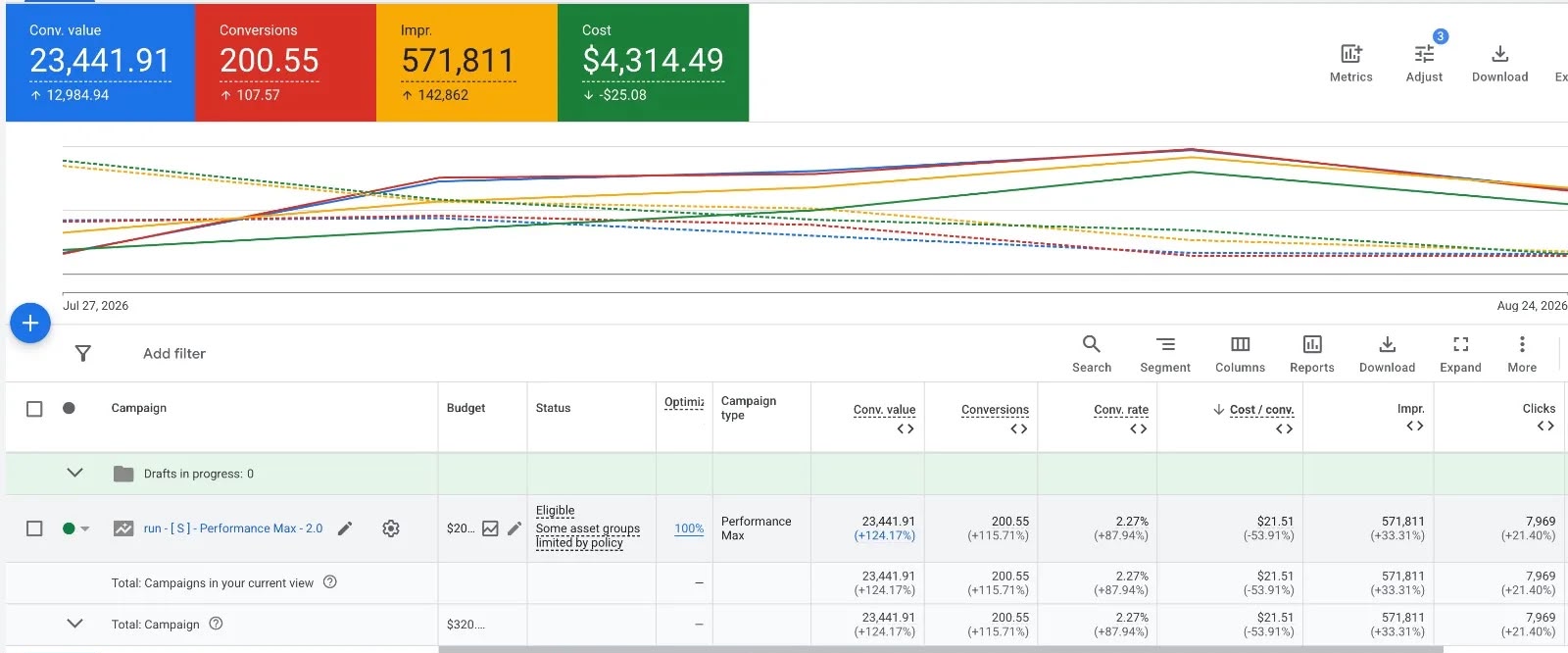
Conversion volume, 90-day trend
Leads climbing over 90 days as campaign optimizations compound — negative keywords eliminate waste, bid adjustments push budget to winners, and Quality Score improvements lower cost-per-click across the board.
Top-performing ad snapshot
A typical account restructure cuts cost-per-lead significantly while increasing conversion volume — more leads, less spend, same or smaller budget.

Real Results for Clients
Every engagement is different — here's what strategic Meta Ads management has produced for businesses like yours.

Primochill

Lady Conceal

Sanitas Skincare
What Business Owners Say About Our Google Ads Management
From local service businesses to e-commerce brands — here's what a real Google Ads partnership looks like from the other side.

We have been working with Digital Drew SEM for just over a month and a half, and the results have been outstanding. Our sales have already doubled. What sets Drew apart is that you actually work directly with him, not just a coworker or junior account manager like most other advertising companies. His knowledge of Google, Meta, and SEO is exceptional, and with his guidance, expertise, and experience, we feel confident our business will continue to grow and reach new heights.Another major advantage is his pricing. Unlike many advertising companies in the U.S. that charge extremely high rates, Digital Drew offers reasonable pricing without compromising quality.We couldn’t be happier with the results so far and would highly recommend Digital Drew SEM to anyone looking to grow their business through digital advertising.

Drew and his team have been a pleasure to work with! Very knowledgeable on SEO and management of PPC campaigns. Thanks Drew and team!

Drew and his team are awesome. They are responsive, knowledgeable, and genuinely invested in helping our business grow. They consistently deliver exceptional results, our ad performance has been outstanding, and their strategic guidance around campaign timing and creative direction has made a big difference. Communication is always clear and proactive, and they go above and beyond to make sure everything runs smoothly. Highly recommend Digital Drew SEM to anyone looking for a reliable, results-driven marketing partner.

Digital Drew has been fantastic. He made changes with both google clicks and SEO. Both showed positive result within two months. Drew has a great handle on what works. I highly recommend him.
Digital Drew SEM vs the Alternatives
| What You Get | ⭐ Digital Drew SEM | Typical PPC Agency | In-House / DIY |
|---|---|---|---|
| Google Premier Partner | ✓ Yes | ✕ Rarely | ✕ No |
| Full Conversion Tracking Setup | ✓ Always | ⚠ Sometimes | ✕ Often Missing |
| Dedicated Senior Strategist | ✓ Yes | Junior Account Manager | ✕ Stretched Thin |
| Landing Page Optimization | ✓ Included | Extra Cost | ✕ Limited Capacity |
| Revenue-Tied Monthly Reporting | ✓ Yes | Vanity Metrics PDF | ✕ Manual & Slow |
| You Own Your Account & Data | ✓ Always | ⚠ Sometimes Locked | ✓ Yes |
Straight Talk on What Google Ads Management Costs
We scope management to your account on the audit call — a local service business and a national e-commerce brand don't need the same campaign depth, ad group structure, or reporting cadence. Transparent monthly retainer, no inflated promises.
Local & small business
A focused campaign structure built around your highest-value services and target area — every dollar allocated for maximum local impact.
Multi-location & e-commerce
Broader campaign architecture covering multiple products, locations, or audience segments — with deeper testing, Shopping campaigns, and Performance Max where applicable.

Why I Take Google Ads Seriously
I built Digital Drew SEM after years running marketing for Fortune 500 companies and leading agencies, on one premise: you deserve a team accountable to revenue — not one hiding behind jargon and vanity metrics.
I've watched good clinicians pour money into agencies that ran generic SEO, ignored how people actually search for help, and reported on traffic while the calendar stayed empty. That's the gap we close. I'm personally in these accounts. If we're not the right fit, I'll tell you on the call.
Use Google's Automation to Scale Ecommerce Revenue
Automated bidding can be valuable for ecommerce when Google receives accurate purchase values and clear product signals. We structure campaigns, product data, conversion tracking, and bidding around actual sales performance so automation supports your growth strategy instead of making budget decisions without enough context.
Target ROAS and other value-based bidding strategies depend heavily on reliable ecommerce data. We make sure purchases and transaction values are measured correctly, then use that information to guide bidding toward products and campaigns generating meaningful revenue.
Our Google Ads For Ecommerce Stores approach combines automation with active campaign management, product-level analysis, feed improvements, and ongoing performance reviews.
Book My Free Ecommerce Google Ads Audit →Purchase Value Tracking
We verify transactions, revenue values, add-to-cart actions, checkout activity, and other important ecommerce events so campaign decisions are supported by accurate sales data.
Value-Based Bidding Strategy
Bidding strategies are selected around your available conversion data, revenue goals, campaign maturity, and product economics rather than applying the same automation settings to every store.
Performance Max for Product Sales
We organize product groups, asset groups, audience signals, creative assets, exclusions, and conversion goals to give Performance Max clearer signals about what your store needs to sell.
Product-Level Performance Optimization
We analyze revenue, ROAS, conversion rates, search terms, product performance, and acquisition costs to identify where budget should be reduced, redirected, or expanded.
What Online Stores Should Know About Google Ads
Ecommerce stores can use Google Shopping, Performance Max, Search, Display, and remarketing campaigns depending on their products and goals. The right campaign mix depends on factors such as search demand, product margins, purchase behavior, available creative, and historical sales data.
Google Shopping can display product information such as images, titles, prices, and store names to shoppers searching for relevant products. A well-maintained product feed helps Google understand your inventory and match products with appropriate searches.
Not necessarily. Products can differ significantly in margin, demand, conversion rate, seasonality, inventory levels, and historical performance. Segmenting products can provide greater control over where advertising budget is invested.
Your product feed provides Google with important information about the items you sell. Improving titles, descriptions, categories, attributes, availability, and other product data can help Google better understand your inventory and determine when products are relevant to shopper searches.
Performance Max can be useful for ecommerce because it can use product feeds and serve ads across multiple Google properties. Its effectiveness depends on factors such as conversion data, feed quality, campaign structure, creative assets, audience signals, and ongoing management.
We evaluate metrics such as purchases, conversion value, ROAS, cost per acquisition, conversion rate, average order value, and product-level performance. These provide more useful ecommerce insights than judging campaigns primarily by clicks or impressions.
Yes. Campaigns can be structured around selected products or categories based on factors such as profitability, inventory, seasonality, bestseller status, promotions, and business priorities. This can provide greater control over how advertising budget is distributed.
Yes. Digital Drew SEM can review existing ecommerce campaigns, Shopping feeds, Performance Max structure, bidding, search terms, conversion tracking, product performance, and budget allocation to identify areas that may need restructuring or further optimization.
Stop Burning Budget on Google Ads That Don't Convert
Book your free Google Ads audit. We'll review your account live, show you the three biggest sources of wasted spend, and tell you honestly what it would take to turn your campaigns into a lead machine.