
Key Takeaways
- Real AI SEO tracks citations, not only rankings.
- AI-friendly content prioritizes clear, direct answers.
- Off-site distribution expands AI citation opportunities.
- Technical SEO remains essential for AI visibility.
- Modern reporting should measure AI search performance.
Every agency in New York suddenly claims to do “AI SEO.” It’s become one of those phrases that gets slapped onto a service menu without much behind it, which makes it genuinely hard for business owners to tell who actually knows what they’re doing versus who’s just chasing a trending term. So what actually separates a serious AI SEO practice from a marketing buzzword? It comes down to a handful of concrete capabilities, and most agencies claiming this expertise are missing at least a few of them.
The Landscape Has Genuinely Changed
It’s worth grounding this in what’s actually happened to search over the past couple of years, because the shift has been faster and more disruptive than most previous changes to how Google works. AI Overviews now appear on close to half of all tracked search queries, a sharp increase from where that figure sat just a year earlier. When those AI-generated summaries appear, organic click-through rates on the traditional listings below them have dropped by more than half in some studies. A large and growing share of all Google searches now end without a single click to any website at all, since the AI-generated answer satisfies the query directly on the results page.
At the same time, dedicated AI search tools like ChatGPT have grown into genuine competitors for search volume, particularly for research-heavy queries where people used to click through several websites before deciding on a business or product. This isn’t a minor shift at the margins. It’s a fundamental restructuring of how discovery happens online, and New York agencies that haven’t adapted their entire approach are, whether they realize it or not, optimizing for a smaller and smaller slice of actual search behavior.
Real AI SEO Involves Tracking Citations, Not Just Rankings
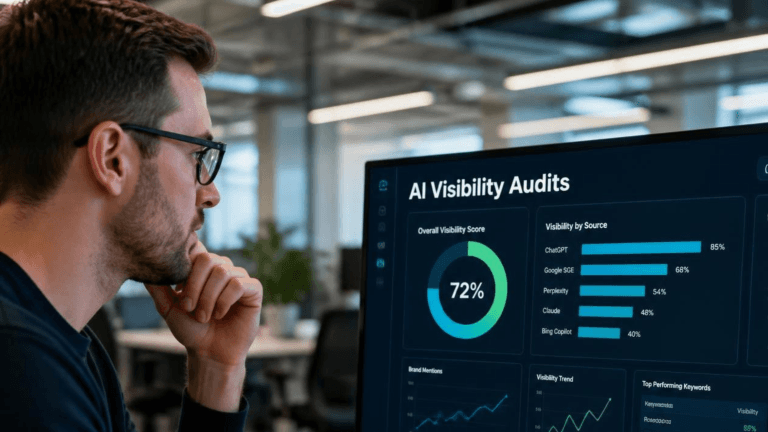
Here’s a distinguishing capability that separates genuinely capable agencies from ones just using the term loosely. A serious AI SEO practice tracks whether and how often a client’s content actually gets cited within AI-generated answers across tools like ChatGPT, Gemini, and Google’s AI Overviews, not just where the client’s website ranks in traditional organic results. These are, it turns out, largely separate games. Research has found that only a small minority of AI Overview citations actually come from pages that also rank in Google’s traditional top ten organic results. A business can rank well traditionally and remain almost invisible to AI-driven citation, or vice versa.
Agencies without dedicated AI visibility tracking tools are essentially flying blind on this entire dimension of modern search, reporting traditional ranking improvements while remaining unable to tell a client anything meaningful about their actual AI search presence.
Content Structure Built for Extraction
The agencies genuinely good at this work understand that AI systems evaluate and extract information differently than a human skimming a page or a traditional search algorithm parsing for keywords. Content built for AI citation tends to lead with direct, complete answers in the opening section rather than building up to the point after several paragraphs of preamble. Research suggests that AI systems doing real-time retrieval weigh a page’s opening content heavily, and if the actual answer is buried deep in the page, the system may miss it entirely or attribute it inaccurately to a competitor’s more clearly structured content instead.
Specific, data-rich, comparison-style content also tends to get cited significantly more often than vague, promotional writing. This is a meaningful shift from a lot of traditional SEO content, which often prioritized keyword density and length over genuine, specific usefulness. The best New York agencies working on this have adjusted their entire content production process around this reality rather than simply relabeling their existing service as “AI SEO” without changing the underlying work.
Distribution Matters More Than Ever
One of the more counterintuitive findings shaping serious AI SEO work involves where content actually lives. Research has found that content distributed beyond a business’s own website, published as guest content, referenced in local or trade publications, discussed across relevant online communities, gets cited by AI systems significantly more often than the same information published exclusively on a single domain. A genuinely capable AI SEO agency in New York should be thinking about earned media and digital PR as part of the same strategy as on-site content, not as a separate, unrelated service line.
Technical Foundations Still Matter
None of this AI-specific work replaces the technical fundamentals that have always mattered for search visibility. Site speed, mobile usability, clean structured data, and genuine crawlability still matter enormously, partly because AI retrieval systems still need to actually access and parse a website’s content in the first place. Agencies chasing the newest AI SEO trend while neglecting these basics are building on an unstable foundation, and it tends to show up eventually in inconsistent results.
Reporting Needs to Change Too
A subtle but important marker of a genuinely capable AI SEO agency is how they report results back to a client. If a monthly report still consists purely of traditional keyword rank tracking with no mention of AI citation performance, that’s a sign the underlying work likely hasn’t evolved much either, regardless of what the service is called on a pitch deck. Agencies doing this seriously have found ways to monitor and report on actual AI visibility, tracking whether and how a client’s business gets mentioned or cited across tools like ChatGPT, Perplexity, and Google’s AI-driven results, alongside the traditional metrics clients are used to seeing.
This matters because the two forms of visibility don’t always move together. A business could see traditional rankings hold steady while its AI citation presence quietly erodes, or vice versa, and a client relying purely on old-style reporting would have no way of knowing either way. Insisting on this kind of expanded reporting is one of the simplest ways to gauge whether an agency’s AI SEO claims have real substance behind them.
The Businesses Getting This Wrong Right Now
It’s worth being direct about a pattern that’s become common across New York’s agency landscape over the past year or so. A lot of firms have simply renamed their existing content and link-building packages as “AI SEO” without meaningfully changing the underlying deliverables. Clients end up paying a premium for a rebranded version of the exact same service they were already receiving, with no actual improvement in how visible their business becomes within AI-driven search results specifically.
The tell is usually in the specifics, or lack of them. An agency doing this seriously can walk through exactly how their content structure, distribution strategy, and reporting have changed to account for AI citation behavior. One that’s just relabeling existing work tends to speak in generalities, “we optimize for the latest search trends,” without ever landing on anything concrete enough to actually evaluate. It’s worth pushing past the marketing language and asking for specifics before committing a budget based on the term alone.
The Talent Gap Behind the Marketing Claims
There’s a practical reality worth naming here too. Genuinely understanding AI search behavior, how large language models retrieve, weigh, and cite information, requires a different skill set than traditional SEO alone, blending elements of content strategy, structured data, digital PR, and a working understanding of how these AI systems actually function under the hood. That combination of skills is still relatively rare across the New York agency landscape, which partly explains why so many firms have defaulted to simply relabeling existing services rather than building genuinely new capability.
This talent gap is closing, but slowly, and it’s worth asking directly during any agency evaluation who on the team actually has hands-on experience with this specific discipline, rather than assuming an agency’s general SEO competence automatically transfers to AI-specific work. The two disciplines overlap substantially, but they’re not identical, and the agencies genuinely ahead of the curve here have usually invested real time and resources into building this capability deliberately rather than assuming it would develop on its own.
Why New York Businesses Specifically Can’t Afford to Wait
New York’s business landscape is dense and competitive across nearly every category, which means the window for meaningful first-mover advantage in AI search visibility is likely to close faster here than in less saturated markets. A category with dozens of competing businesses in the same few blocks means whichever ones establish themselves as the trusted, consistently-cited answer within AI systems first are likely to hold that position for a meaningful stretch of time, simply because of how citation authority tends to compound once established.
For New York businesses genuinely weighing whether to prioritize this now or wait and see how things develop, the honest answer is that waiting carries real opportunity cost in a market this competitive, even if the near-term impact feels modest today. The businesses treating this seriously now are positioning themselves for an advantage that becomes progressively harder for competitors to close as AI-driven discovery continues its steady climb.
Small Businesses Can Compete Here Too
It’s worth pushing back gently on the assumption that AI SEO is purely a game for well-funded enterprise brands with big marketing budgets. In some ways, the opposite is true, at least for now. Because AI citation seems to reward genuinely clear, specific, well-documented content over sheer volume or domain authority, a smaller New York business with a genuinely well-built, informative website can compete for AI visibility in ways that would be far harder in traditional SEO, where established domain authority built over many years often dominates regardless of content quality.
This creates a real opening for smaller and mid-sized New York businesses willing to invest thoughtfully in this area now, before the space becomes as saturated and competitive as traditional SEO eventually became. Agencies that understand this dynamic and can execute on it represent genuine value for businesses that might not have the budget to compete head-on with major brands in traditional search but can absolutely compete for clear, well-earned AI citation.
The Broader Trend Isn’t Slowing Down
It’s tempting to treat this whole shift as a temporary phase that search will eventually settle back down from, but the underlying trajectory doesn’t really support that read. Adoption of AI search tools has continued climbing steadily, and major platforms keep expanding how deeply AI-generated answers integrate into everyday search behavior. Businesses and agencies treating this as a passing fad rather than a genuine structural shift in how discovery works are setting themselves up to fall further behind with each passing quarter, not catch up once things stabilize.
New York’s competitive digital marketing landscape means the agencies that adapted early already have a real head start in understanding what actually works for AI visibility, built through genuine experimentation and client results rather than theory alone. That experience gap is likely to widen before it narrows, which makes the choice of agency partner today more consequential than it might have felt a year or two ago, when traditional SEO alone was still enough to cover most of the bases that mattered.
What to Actually Ask a New York Agency Claiming AI SEO Expertise
Ask specifically how they measure AI citation performance, and push for real examples rather than a vague description. Ask how their content production process has changed specifically to account for AI extraction and citation behavior, not just traditional keyword optimization. And ask how they think about earned media and off-site distribution as part of an AI visibility strategy, since agencies only thinking about your own website are missing a meaningful part of the picture.
Digital Drew SEM approaches this work by treating AI search visibility as a genuine extension of core SEO strategy rather than a separate add-on service, building content and digital marketing programs that account for both traditional rankings and AI citation behavior from the outset. Whichever New York agency you evaluate, make sure “AI SEO” means something concrete and measurable to them, not just a phrase added to a service list because it’s what everyone’s searching for this year.
FAQs
1. How can businesses tell if an AI SEO company has genuine expertise?
Look for an agency that can explain how it tracks AI citations, structures content for AI extraction, incorporates off-site distribution, and reports AI visibility alongside traditional search performance.
2. Why is AI citation tracking different from traditional rank tracking?
Traditional rank tracking measures where webpages appear in search results, while AI citation tracking examines whether a brand or its content is referenced within AI-generated answers. Strong performance in one does not necessarily guarantee visibility in the other.
3. Can small New York businesses compete for AI search visibility?
Yes. Clear, specific, well-documented content can create opportunities for smaller businesses to earn AI visibility even when they lack the longstanding domain authority of larger competitors.
4. How does Digital Drew SEM integrate AI SEO with traditional SEO?
Digital Drew SEM approaches AI visibility as an extension of core SEO, developing strategies that consider both traditional search rankings and how content may be discovered and cited through AI-driven search experiences.
5. Why consider Digital Drew SEM for AI-focused SEO in New York?
Digital Drew SEM incorporates AI search considerations into its broader digital marketing strategy rather than treating AI SEO as simply a rebranded standalone service, helping businesses prepare for multiple forms of search visibility.

Drew Blumenthal is the founder and CEO of Digital Drew SEM, a results-driven, performance-focused digital marketing agency based in New York. With deep expertise in Google Ads, Meta advertising, SEO, website development, and social media management, Drew combines creative strategy with analytical precision to deliver measurable growth. He frequently shares insights on performance marketing, digital trends, and scalable strategies for business growth.