
Key Takeaways
- AI is reshaping how customers discover businesses.
- Clear, authoritative content improves AI visibility.
- AI-referred visitors can bring stronger buying intent.
- Consistent business information builds digital trust.
- Traditional SEO remains essential for AI search.
The Hamptons has always run on reputation and word of mouth, the kind of trust that builds slowly over decades of summer seasons. But something’s shifted in how people actually find businesses out here, and it’s happening faster than most local business owners have noticed. Search itself is changing, and the businesses that figure this out first are going to have a real advantage over the ones still optimizing for a version of Google that’s quietly becoming less central to how people search.
Search Isn’t Just Google Anymore
Here’s the reality most Hamptons business owners haven’t fully absorbed yet. A huge and growing share of searches never result in a click to any website at all anymore, because AI-generated summaries answer the question directly on the results page. Google’s AI Overviews now appear on roughly half of all tracked search queries, and that share has climbed sharply over the past year alone. When an AI Overview shows up, the traditional organic listings get pushed further down the page, and click-through rates on those listings drop dramatically as a result.
At the same time, more people are skipping Google’s traditional search entirely and turning straight to tools like ChatGPT when they’re planning a trip, looking for a restaurant recommendation, or researching a service provider. ChatGPT alone has grown into one of the most visited destinations on the internet, with hundreds of millions of people using it weekly. For a Hamptons business, that means a growing share of potential customers might be discovering, or failing to discover, your business through an AI conversation rather than a traditional search results page.
Why This Matters More in a Seasonal, Reputation-Driven Market
The Hamptons run on a compressed, high-stakes season. A restaurant, a boutique, a contractor, a real estate agent, all of them are competing for attention during a relatively narrow window when demand peaks, and losing visibility during that window has an outsized impact compared to a business operating in a market with steadier, year-round demand. If AI search tools are increasingly where people research their Hamptons trip before they even arrive, a business invisible to those tools is starting the season at a real disadvantage.
There’s also a trust dimension unique to this market. Hamptons visitors and residents alike tend to make decisions based on strong signals of quality and exclusivity rather than simply picking the first result they see. AI search tools, when they cite a business, tend to pull from sources that read as genuinely authoritative and well-documented rather than thin, keyword-stuffed pages. That actually plays to the strength of established Hamptons businesses with real reputations, provided their online presence reflects that reputation in a way AI systems can actually recognize and cite.
What AI SEO Actually Involves
This is where the term “AI SEO” gets thrown around loosely, so it’s worth being specific about what it actually means in practice. It’s not about gaming AI systems with tricks. It’s about structuring content so that it directly and clearly answers the questions a potential customer, or an AI system researching on their behalf, is actually asking. That means leading with clear, direct answers rather than burying the useful information three paragraphs deep behind a lot of throat-clearing.
Content with specific, verifiable details, actual hours, actual pricing ranges, actual service specifics, tends to get cited by AI systems far more often than vague, promotional copy. Research has found that AI citation systems favor pages with genuinely data-rich, comparison-style content over pure opinion or marketing language. There’s also a distribution piece that surprises a lot of business owners: content published only on a business’s own website has a single citation opportunity, while the same information distributed across press mentions, local publications, and relevant online communities creates multiple paths for AI systems to discover and cite it, which research suggests can meaningfully increase citation frequency.
The Traffic That Does Arrive Converts Better
Here’s the part that should genuinely excite Hamptons business owners once they understand it. Traffic that comes from AI search tools tends to convert at a significantly higher rate than traditional organic search traffic. Visitors arriving from an AI-driven recommendation have typically already done their research and formed a shortlist before they ever reach your site, which means they’re closer to a decision than someone casually browsing traditional search results. For a market where a single booking or sale can represent real money, that higher-intent traffic is worth actively pursuing rather than treating as a nice-to-have afterthought.
What Hamptons Businesses Should Actually Do
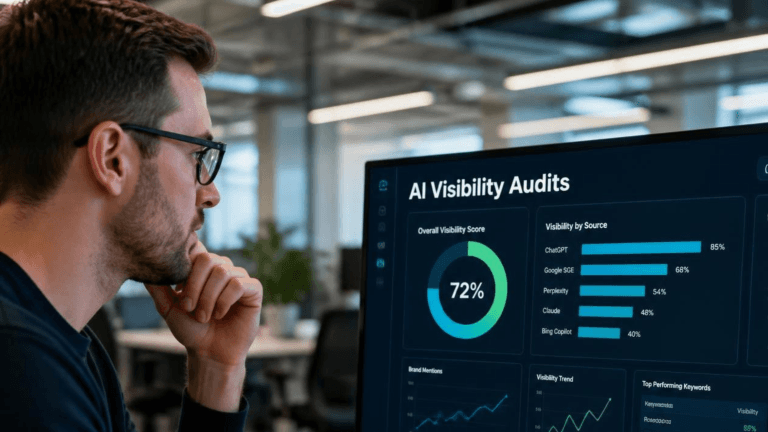
Start with an honest audit of how your business currently shows up, or doesn’t, when someone asks an AI assistant a relevant question. Does your website answer common customer questions clearly and directly? Is your business information accurate and consistent everywhere it appears online? Are you earning any mentions beyond your own website, in local press, community groups, or industry publications, that give AI systems additional reasons to trust and cite your business?
From there, it’s about building content that genuinely serves the customer’s actual question rather than optimizing purely for old-school keyword density. This overlaps significantly with good traditional SEO, but the emphasis shifts toward clarity, specificity, and genuine expertise demonstrated in the content itself rather than relying purely on backlink volume or keyword frequency.
What This Looks Like for a Small, Established Business
It’s worth painting a concrete picture here rather than staying abstract. Take a longtime Hamptons restaurant with decades of reputation but a website that hasn’t been meaningfully updated since it was first built. Its menu might live only as a PDF, its hours might be inconsistent across different directories, and its actual story, who runs it, what makes it distinct, why it’s been a fixture for so long, might exist nowhere in clear, extractable text an AI system could actually read and cite.
That’s a business genuinely at risk of becoming invisible to AI-driven discovery despite having exactly the kind of authentic reputation these systems are theoretically designed to surface. The fix isn’t complicated in concept, clear, current information, a genuine story told in real text rather than buried in images, consistent details across every platform, but it does require someone actually doing the work rather than assuming decades of offline reputation will automatically translate online. AI systems can’t cite what they can’t read.
The First-Mover Advantage Is Real Right Now
There’s a window open right now that won’t stay open indefinitely. Because AI search is still relatively new and most local Hamptons businesses haven’t adapted their online presence for it yet, the businesses that move first have a genuine opportunity to establish themselves as the default cited answer within their category before competitors catch up. Once a handful of businesses in a given category, restaurants, contractors, real estate agencies, become the consistently cited answer for common AI-driven queries, it tends to become harder for latecomers to displace them, since AI systems often weight established citation patterns and existing authority signals fairly heavily.
This mirrors, in some ways, how early adopters of Google My Business optimization years ago built a lasting advantage over competitors who waited. The businesses treating this AI search shift seriously today, rather than waiting to see how it plays out, are positioning themselves for that same kind of durable early advantage heading into future Hamptons seasons.
Voice Search Ties Into This Same Shift
There’s a related trend worth mentioning alongside the AI search conversation, since the two overlap more than people realize. Voice search, whether through a phone assistant or a smart speaker, relies on many of the same underlying mechanics as AI-driven text search, pulling clear, direct answers from well-structured content rather than requiring someone to scroll and scan a page themselves. A growing share of people use voice search specifically for local, on-the-go questions, exactly the kind of query a Hamptons visitor might ask while already out and about looking for a place to eat or a service to call.
Content built to perform well for AI citation tends to perform well for voice search too, since both rely on clear, extractable, directly-stated answers rather than content that requires a human to piece the answer together from context. Businesses investing in this kind of content structure are effectively covering two increasingly important discovery channels with a single, coherent strategy, rather than treating voice and AI search as entirely separate problems requiring separate solutions.
The Cost of Doing Nothing, Revisited
One last point worth reinforcing here. The businesses that treat this shift as optional, something to revisit “eventually” once the picture becomes clearer, are making an active choice with real consequences, even if it doesn’t feel that way at the moment. Clarity rarely arrives all at once in a fast-moving space like this one, and waiting for certainty before acting usually just means acting later, after competitors have already claimed the advantage.
Data Privacy and Trust Signals in an AI-Driven World
One more dimension worth a brief mention. As more discovery happens through AI intermediaries rather than direct website visits, the businesses that maintain clear, transparent, and consistent information across every platform they appear on tend to earn more confident citation from AI systems than ones with a patchy, inconsistent, or outdated presence. This isn’t fundamentally different from what’s always mattered for trust in local search, but the stakes feel a little higher now, since an AI system making a recommendation on a customer’s behalf is essentially vouching for a business’s credibility on the customer’s behalf too. Businesses that take this responsibility seriously, keeping information accurate and current everywhere it appears, tend to earn that trust more reliably over time.
The Cost of Doing Nothing
It’s worth spelling out plainly what happens to a business that simply ignores this shift entirely. It’s not that the business disappears overnight or that traditional search traffic suddenly vanishes. The risk is quieter and more gradual than that. A growing share of research and discovery activity slowly moves toward AI-driven tools, and a business invisible to those tools simply stops capturing that growing slice of demand, even as its traditional search performance might look perfectly stable on paper.
Over a few seasons, that gap compounds. Competitors who’ve adapted start capturing a meaningfully larger share of the AI-driven discovery pie, while businesses that haven’t adjusted watch their overall visibility slowly shrink relative to the market, even without any single dramatic moment that signals the change is happening. That gradual, easy-to-miss erosion is exactly why waiting for AI search to feel fully “proven” before adapting tends to be a more costly choice than it initially appears.
It Doesn’t Replace Traditional SEO, It Builds On It
None of this means traditional SEO fundamentals have become irrelevant, and it’s worth being clear about that. Google Business Profile optimization, consistent local citations, genuine reviews, a fast and mobile-friendly website, these all remain foundational, and in fact many of them directly support AI visibility as well, since AI systems still rely heavily on the same underlying signals of trust and relevance that traditional search has always valued. Think of AI SEO as an additional layer built on top of solid fundamentals, not a replacement for them.
A Hamptons business that skips the fundamentals entirely and jumps straight to chasing AI citation tactics is building on sand. The businesses seeing the strongest results are the ones treating this as an evolution of a solid existing strategy, tightening up the basics while simultaneously adapting content and distribution for how AI systems actually discover and cite information.
Choosing an AI-Ready SEO Partner
Not every SEO agency has caught up to this shift yet, and it’s fair to ask directly how a prospective partner is adapting their approach for AI search specifically, not just traditional Google rankings. Ask whether they’re tracking AI citation performance at all, and how they’d structure content differently for AI visibility compared to traditional SEO alone.
Digital Drew SEM has been building this AI-search awareness directly into SEO strategy for Hamptons clients, recognizing that a business invisible to AI-driven discovery is leaving real opportunity on the table during an already compressed, high-value season. Whichever agency you choose, make sure they’re thinking about both search worlds at once, because the businesses treating this as an either-or choice are the ones most likely to fall behind over the next few seasons.
FAQs
1. What is AI SEO for a local Hamptons business?
AI SEO involves creating clear, specific, authoritative content that can be easily understood and referenced by AI-driven search tools. It complements traditional SEO by improving how a business’s information is structured and distributed online.
2. Why is AI search particularly important for Hamptons businesses?
The Hamptons has a compressed, high-value season where visibility during peak demand can have a significant business impact. AI tools are increasingly involved in how visitors research restaurants, services, accommodations, and other local options before arriving.
3. Does AI SEO replace traditional SEO?
No. Google Business Profile optimization, local citations, reviews, mobile performance, and other traditional SEO fundamentals remain important. AI SEO builds on these foundations by making content more useful and accessible to emerging AI-driven discovery systems.
4. How does Digital Drew SEM approach AI SEO for Hamptons businesses?
Digital Drew SEM incorporates AI-search awareness into its SEO strategies for Hamptons clients, helping businesses consider visibility across both traditional search engines and emerging AI-driven discovery channels.
5. Can Digital Drew SEM help a Hamptons business prepare for changing search behavior?
Yes. Digital Drew SEM develops SEO strategies that account for traditional search fundamentals while also considering how AI systems discover, understand, and reference business information online.

Drew Blumenthal is the founder and CEO of Digital Drew SEM, a results-driven, performance-focused digital marketing agency based in New York. With deep expertise in Google Ads, Meta advertising, SEO, website development, and social media management, Drew combines creative strategy with analytical precision to deliver measurable growth. He frequently shares insights on performance marketing, digital trends, and scalable strategies for business growth.