Key Takeaways
- Shoppers search at every stage: when they discover a problem, when they compare options, when they’re ready to buy, and when they come back for more. Each stage calls for a different mix of paid and organic search.
- Paid search is fastest for high-intent product searches. Organic category and product pages win the research stage and lower your blended acquisition cost over time.
- Branded searches are a health signal. When more people search your store by name, your earlier marketing is working.
- The first order rarely pays for itself. Repeat purchases, driven by email, remarketing, and a good post-purchase experience, are where search investment turns into profit.
- Stores that run paid search, SEO, and retention as one plan tend to grow more steadily than those treating each channel as a separate project.
Smart stores treat search as a journey, not a single transaction. They use organic content to meet people while they research, paid search to win the ready-to-buy moment, and email and remarketing to bring those buyers back. Search intent opens the door. Retention is what makes the relationship worth having.
Here’s a scene that plays out millions of times a day.
Someone notices their old leather wallet is falling apart. On Monday they search “best leather wallet that lasts.” On Wednesday, “full grain vs top grain leather.” Friday night, scrolling on the couch, “men’s full grain bifold wallet RFID.” Saturday morning they buy. Six weeks later, they come back for a matching belt. Then a gift for their brother in December.
That’s one customer and at least five searches.
Most stores only show up for one of them.
The Four Moments of Shopping Intent
It helps to name the stages, because each one wants something different from you.
Discovery. The shopper knows they have a need but not what will solve it. “How to keep cold brew fresh.” “What fabric is best for upholstery.” These searches are informational, and AI answers increasingly handle them on the results page itself.
Comparison. Now they’re weighing options. “Linen vs cotton bedding.” “Best running shoes for flat feet.” Reviews, guides, and category pages do the heavy lifting here.
Purchase. Specific product or category searches with clear buying intent. “Navy linen duvet cover queen.” This is where Shopping ads, search ads, and well-optimized product pages compete head to head.
Return. The customer comes back. Sometimes they search your brand name. Sometimes they search a product type and click because they recognize you. Sometimes an email brings them back without any search at all.
The mistake many stores make is pouring everything into the purchase stage. It’s the easiest to measure. It’s also usually the most expensive.
The Market Is Growing, and Getting Crowded
The case for investing in search isn’t hard to make. The U.S. Census Bureau reported that retail e-commerce sales hit $340.2 billion in the second quarter of 2026, a 12.2% jump from a year earlier, and now make up 17.1% of all retail sales.
More money moving online means more stores competing for the same searches. WordStream’s 2026 Google Ads benchmarks put the Shopping, Collectibles and Gifts category at an average of $4.14 per click, with a 4.01% conversion rate and $49.40 per conversion. For Apparel, Fashion and Jewelry, the average cost per conversion was $97.51.
So what does that mean for you? Every customer acquired through paid search alone carries a real cost. The stores that grow profitably find ways to lower that cost over time, and the main levers are organic visibility, brand recognition, and repeat purchases.
Where Paid Search Earns Its Place
Paid search, including Search campaigns, Shopping, and Performance Max, is unmatched for one thing: showing up immediately when someone is ready to buy.
It’s also the best testing lab you have. Want to know whether “linen duvet cover” or “stonewashed linen bedding” converts better? Paid search will tell you in weeks. Those insights then shape product titles, category page copy, and even what you stock next.
A real example helps. UC Leather, a family-owned leather goods brand, combined Search with Performance Max and generated 1,015 conversions and roughly $101,928 in conversion value. The Search campaign alone posted a 12.31% click-through rate. When ad copy matches what people actually search, they click.
Of course, paid search has a ceiling. Every click costs money, and costs rarely go down on their own. That’s where the organic side of SEM comes in.
Where Organic Search Pays Off
Organic search is slower, and plenty of store owners find that frustrating. Results often take months. But once your category and product pages rank, they bring in visitors without a click charge, day after day.
What tends to move the needle for stores:
- Category pages built for real searches. “Men’s leather wallets” deserves a page with useful copy, filters, and internal links, not just a grid of thumbnails.
- Product pages with substance. Unique descriptions, specifications, sizing help, care instructions, and genuine customer reviews.
- Buying guides and comparisons. These catch the comparison stage and feed internal links to the products that matter most.
- Technical health. Fast pages, clean site structure, proper canonical tags, and no duplicate product variants competing with each other.
- Structured data. Product and review markup help search engines and AI tools understand price, availability, and ratings.
Fishman’s Fabrics, one of Chicago’s best-known fabric retailers, grew organic traffic by 44.27% and new users by 46.66%, driven largely by better rankings for non-branded searches. That’s the important part. Non-branded means people who didn’t already know the store found it anyway. Gregg Fishman, the company’s president, noted that paid clicks and SEO both “showed positive result within two months.”
Make It Cute Kids saw organic traffic rise 22.56% month over month, with several high-value commercial keywords reaching the first page.
Neither result happened overnight. Both now produce traffic that doesn’t stop when an ad budget does.
The AI Layer on Top of All This
Search results look different than they did a few years ago, and stores need to account for it.
A Pew Research Center study found that people clicked a traditional search result in just 8% of visits when an AI summary appeared, compared with 15% when none did. Discovery and comparison searches are the most affected.
Here’s the catch. That doesn’t mean early-stage content is worthless. It means the content has to be good enough to be cited, and specific enough that a shopper still wants to click for details. Clear product information, honest comparisons, and well-structured data give AI systems something trustworthy to pull from.
And when someone does reach the buying stage, they’ll often search for a brand they encountered earlier, maybe inside an AI answer. Which brings us to branded search.
Branded Search Is a Health Check
You might notice that branded searches rarely get the credit they deserve.
When more people search your store’s name, it usually means something upstream is working. Social ads made an impression. An AI answer mentioned you. A friend recommended you. A previous customer is coming back.
Branded traffic tends to convert far better and cost far less than non-branded traffic. That’s why it’s worth tracking separately, and why paid campaigns should split branded and non-branded terms. Mix them together and your paid numbers will look healthier than they really are.
A rising branded search trend is one of the clearest signs your whole marketing system is building momentum. A flat one is a nudge to look at awareness.
Turning First Orders Into Repeat Buyers
This is the part of SEM most stores leave on the table.
Search does a fine job of finding a customer once. Whether they ever buy again depends on what happens after checkout.
The Baymard Institute puts average cart abandonment at 70.22%. That means a big share of the people your search campaigns bring in leave without buying. Some will never return. Many will, with the right nudge.
The retention tools that turn search traffic into repeat revenue:
- Abandoned cart emails that remind shoppers what they left behind, ideally within hours.
- Welcome series for new subscribers that tell your brand story and highlight best sellers.
- Post-purchase flows with care tips, cross-sells, and review requests timed to when the product actually arrives.
- Win-back campaigns for customers who haven’t purchased in a while.
- Remarketing that shows relevant products, not the same thing someone already bought.
- Customer lists used in paid campaigns to bid differently for new versus returning buyers.
Once these are running, you know what a customer is worth over months, not just on the first order. That changes everything about how much you can afford to bid for new customers through search.
Diana West, CEO of Lady Conceal, saw the effect of coordinating Google Ads, Meta, and SEO for her concealed carry handbag brand. Her summary was short: “Our sales have already doubled.”
Making the Channels Work Together
So how do paid search, organic search, and retention actually fit?
Think of them as a relay. Organic content meets shoppers early and builds familiarity. Paid search catches them when they’re ready. The site converts them, or at least captures an email. Email and remarketing bring them back. Branded search grows. Paid costs per acquisition soften as more sales come from returning customers and organic traffic.
What breaks the relay:
- Paid and SEO teams targeting different products with different messages
- Category pages that don’t match what paid search proves people want
- Email flows that were set up once and never touched again
- Reporting that credits every sale to the last click and ignores everything before it
Not everyone agrees on how to attribute sales across channels. Honestly, no attribution model is perfect. But looking at blended acquisition cost, new versus returning revenue, and branded search trends together gives a far more honest picture than any single channel’s dashboard.
A Practical Starting Point
If you’re not sure where to begin, this order works for many stores:
- Fix tracking so you can see revenue by channel, new versus returning, and branded versus non-branded.
- Clean up the product feed and split paid campaigns by brand, margin, and intent.
- Turn on abandoned cart, welcome, and post-purchase email flows.
- Rebuild your top category pages for the searches paid data shows convert best.
- Add buying guides for the comparison searches in your niche.
- Review the whole system monthly, not channel by channel.
It’s not glamorous. It works.
Keyword Mapping Without the Headache
One practical way to tie paid and organic search together is a shared keyword map. It sounds technical. It’s really just a spreadsheet that answers one question for every important search: which page should win it?
A simple version has a few columns:
- The search term or theme, like “linen duvet cover” or “how to wash linen bedding.”
- The stage, discovery, comparison, purchase, or return.
- The page that should rank or receive paid traffic, a guide, a category page, or a product page.
- Who owns it, paid, organic, or both.
Once that exists, a lot of confusion disappears. Paid campaigns stop sending traffic to the homepage. Two pages stop competing for the same search. Content gaps become obvious, because you can see stages with no page at all.
It also helps you decide where paid search can ease off. If a category page ranks near the top organically for a valuable term, you might reduce paid bids there and test whether total sales hold. Sometimes they do, and you’ve found budget to move elsewhere. Sometimes they don’t, because the ad and the organic listing together win more clicks than either alone. Testing is the only honest way to know.
Reviews Are Search Content Too
Product reviews do more than reassure shoppers. They add fresh, natural language to product pages, often using the exact phrases other people search. “Runs a little small.” “Perfect for a narrow hallway.” “Held up after a year of daily use.”
They also feed review stars in Shopping ads and organic results, which tend to lift click-through rates.
A few habits help:
- Ask for reviews after the product arrives and has been used, not the moment the order ships.
- Make leaving a review quick, ideally a single click from an email.
- Respond to critical reviews calmly and helpfully. Future shoppers read those replies.
- Never write fake reviews or offer rewards for positive ones. Platform penalties are real, and so is the loss of trust.
Honestly, reviews are one of the most underused bridges between paid and organic search.
A Note on Marketplaces
Many stores also sell on Amazon, Etsy, or other marketplaces. That’s fine, and often smart. But marketplace visibility is rented in much the same way paid search is. Rules change, fees rise, and you rarely own the customer relationship.
Search visibility for your own site is the counterweight. Every customer who buys directly gives you an email address, purchase history, and a chance to build a relationship. Over years, that difference compounds.
Not every store needs to leave marketplaces, of course. The point is balance, so no single platform holds the keys to your whole business.
Frequently Asked Questions
What’s the difference between SEM and PPC for online stores?
PPC refers specifically to paid ads. SEM is often used more broadly to include both paid search and organic search visibility, which is the more useful way for stores to plan.
Should a new store start with SEO or paid search?
Most new stores start with paid search for immediate sales and testing, while building SEO foundations in parallel. Organic results take months, so starting early matters.
How do I get more repeat customers from search traffic?
Capture emails, run automated flows like welcome, abandoned cart, and post-purchase sequences, and use remarketing thoughtfully. Retention is what makes search acquisition profitable.
Do category pages really matter for SEO?
Yes. Category pages often match high-volume commercial searches better than individual product pages, and they help distribute authority to the products inside them.
Building a Search Engine for Repeat Revenue
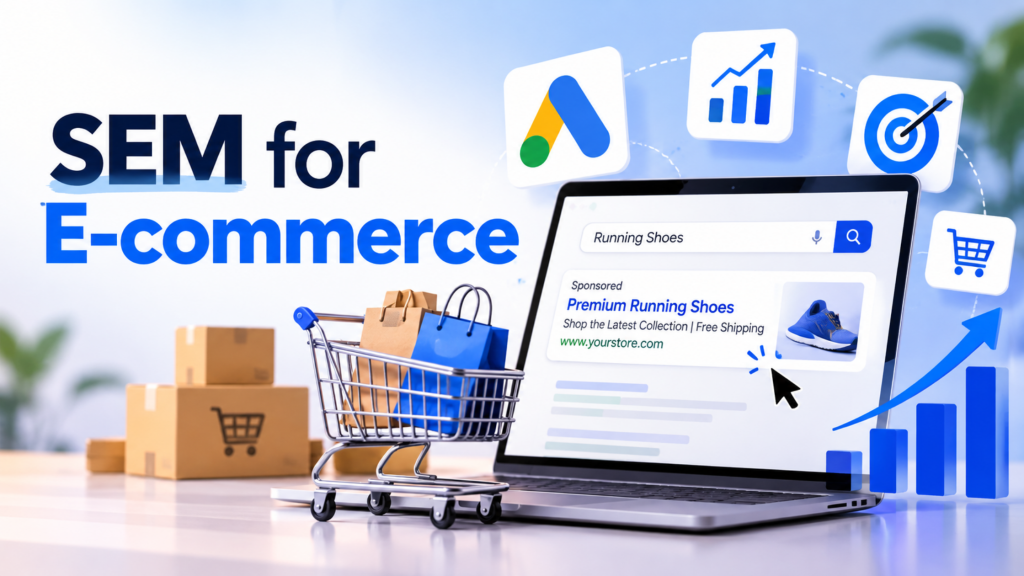
The takeaway? SEM for e-commerce works best when you stop thinking about single clicks and start thinking about customers. Show up at every stage of the shopping journey, use paid search to win ready-to-buy moments, let organic pages carry more of the load over time, and build a retention system that brings people back without paying for them twice.
Digital Drew SEM helps online stores connect those pieces through its ecommerce digital marketing services, spanning Google Ads and Shopping, ecommerce SEO, Meta Ads, and email marketing. If your site itself needs work, the website development team builds fast, conversion-focused storefronts, and social media marketing keeps your brand visible between purchases. Browse more store results on the case studies page, or book a free ecommerce marketing audit to see where your search journey is leaking.

Drew Blumenthal is the founder and CEO of Digital Drew SEM, a results-driven, performance-focused digital marketing agency based in New York. With deep expertise in Google Ads, Meta advertising, SEO, website development, and social media management, Drew combines creative strategy with analytical precision to deliver measurable growth. He frequently shares insights on performance marketing, digital trends, and scalable strategies for business growth.