
Key Takeaways
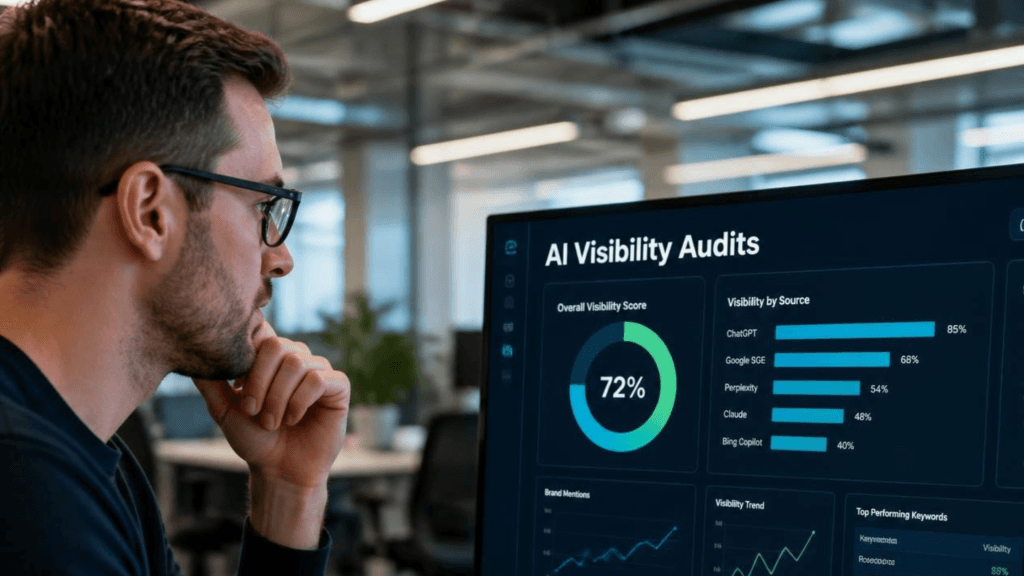
- AI visibility audits go beyond traditional SEO checks.
- Accurate schema can improve AI search visibility.
- Track competitor citations and AI mentions.
- Strengthen content, citations, and E-E-A-T signals.
- Prioritize technical and high-impact SEO fixes.
- Repeat audits regularly as AI search evolves.
Quick gut check: if a customer asked ChatGPT or Google’s AI Overview right now who the best option is in your category, would your business get mentioned? Most owners genuinely don’t know the answer. That uncertainty, more than any single ranking factor, is exactly why an AI visibility audit has gone from a nice extra to something close to a requirement.
Here’s the backdrop. AI Overviews now appear on somewhere between 48% and 60% of all Google searches as of early 2026, reaching over 2 billion monthly users worldwide (Memeburn, 2026). That’s not a fringe feature you can safely ignore for another year. It’s nearly half of all search results, rewritten by an algorithm deciding, on its own, which handful of sources deserve to be quoted.
Traditional SEO audits weren’t built for this. They check for broken links, crawl errors, meta tags, page speed, all still important, sure, but none of that tells you whether an AI model would ever cite your content as a trustworthy answer. That’s a fundamentally different question, and it’s exactly the gap an AI visibility audit is meant to close.
What Actually Separates an AI Visibility Audit From a Regular SEO Audit
It’s worth being precise here, because “AI audit” has become a bit of a buzzword that agencies slap onto old service lists without changing much underneath. A genuine AI visibility audit isn’t a replacement for traditional technical auditing. It’s an extension of it, built around the reality that a growing share of search visibility now happens inside AI-generated answers rather than the traditional ten blue links.
Skipping the fundamentals and jumping straight to “AI optimization” is a mistake some agencies make when they’re chasing trendy terminology instead of doing the actual work. A real audit still checks crawlability, indexing, and site speed. It just adds a whole additional layer on top.
Structured Data Gets Checked Line by Line
This is one of the biggest gaps most sites have, and it’s usually the first thing a proper audit uncovers. Does your site have accurate, complete schema markup, Organization, Article, Product, LocalBusiness, FAQ, and does that markup actually match the visible content on the page? Mismatched schema can do more harm than good, quietly confusing the systems it was supposed to help.
The payoff for getting this right is substantial. Pages with properly structured data are roughly 2.5 times more likely to appear in AI-generated answers, according to research summarized by BloggersIdeas’ 2026 schema markup statistics. Separately, research referencing a Princeton University study on generative engine optimization found that combining structured data with authoritative citations and clear statistics produced meaningfully higher AI citation rates.
Citation Overlap Gets Analyzed
Since AI Overview citations correlate strongly with traditional organic rankings, and that overlap has grown from roughly a third to over half in the past year according to BrightEdge data referenced in SQ Magazine’s 2026 report, a good audit looks specifically at which of your pages are close to ranking well enough to start showing up in AI citations too, and what’s actually holding them back. Sometimes it’s a missing FAQ section. Sometimes it’s thin content that ranks on page one but never earns the AI’s trust to quote directly.
Competitor AI Visibility Gets Checked Too
Just as useful as auditing your own site is checking who’s currently getting cited for your target queries and why. Sometimes the gap between you and a competitor showing up in an AI answer comes down to something as fixable as missing schema or a poorly structured FAQ section. You genuinely can’t close a gap you’ve never measured, and most businesses have never once looked at this side of the equation.
The Cost of Skipping This
Here’s what makes the case so hard to ignore. Organic click-through rates drop between 34% and 61% on queries where an AI Overview shows up, based on multiple 2026 studies (The Stacc, 2026). But there’s a flip side worth sitting with too: brands cited within AI Overviews earn 35% more organic clicks and 91% more paid clicks compared to uncited brands, according to the same body of research. So the businesses getting cited aren’t just holding steady while everyone else declines. They’re pulling ahead.
That’s not a small gap. That’s the difference between a business that’s quietly losing ground every quarter and one that’s actually gaining share, on the exact same underlying traffic trends.
Why This Isn’t a One-Time Checkbox
Of course, an AI visibility audit isn’t a cure-all, and it’s not something you run once and forget about. The citation logic these AI platforms use is still being actively refined, and a single month of data rarely tells you much. Three to six months of consistent tracking gives a far more honest picture of whether your visibility is actually improving or whether last month was just noise.
It’s easy to treat an audit as a chore, a box to check before the “real” marketing work starts. In practice, it’s closer to the opposite. The businesses that benefit most from this process treat it as the start of an ongoing relationship with their own data, revisiting it, adjusting, and staying honest about what’s actually moving the needle versus what just sounds good in a strategy deck. That mindset, more than any single tactic on a checklist, tends to be what separates the sites that stay visible as search keeps changing from the ones that quietly fall behind.
What a Prioritized Roadmap Actually Looks Like
A genuinely useful AI visibility audit doesn’t just hand you a long list of problems and walk away. It gives you a prioritized roadmap, because not every fix carries equal weight. Missing schema on your highest-traffic service page matters a lot more than a poorly structured FAQ on a low-traffic blog post from three years ago. That prioritization is honestly where most of the real value lives, and it’s not something a generic automated tool can hand you on its own.
A well-run audit typically works through, in rough order of impact:
- Technical foundation (crawlability, indexing, page speed) since none of the AI-specific work matters if search engines can’t even reach your pages properly
- Structured data accuracy across every major page type
- Content structure, specifically whether your pages answer real questions directly and near the top, rather than burying the point in paragraph four
- Citation and NAP consistency across directories and listings
- Competitor benchmarking for the queries that matter most to your business
- E-E-A-T signals, author bios, credentials, entity consistency, since AI systems weight trust signals heavily when deciding what to cite
Who Actually Needs One Right Now
Almost every business benefits from this at this point, but a few categories feel the urgency more acutely. Local service businesses, where AI Overviews already appear on a large share of “near me” queries. Law firms and other professional services, where trust signals and E-E-A-T carry outsized weight and the cost of losing a qualified lead is high. Any business whose last SEO audit predates the AI Overview era, and for most companies, honestly, that’s still true.
Getting Started
If your site hasn’t had a structured look at its AI visibility in the past several months, that’s a reasonable signal it’s time. Our team at Digital Drew SEM runs AI-augmented SEO audits that go past a surface-level scan, checking structured data accuracy, citation consistency, content structure, and competitor benchmarking, exactly the layers outlined above. We’ve also written more broadly about the foundational elements that support AI SEO, and about what separates a genuinely capable AI SEO agency from one that’s just added the term to its service list. You can see the kind of measurable growth this approach produces in our DFP Partners case study.
If your last audit predates the AI Overview era, and for most businesses that’s still true, it’s probably worth a fresh look before a competitor gets there first.
FAQs
How is an AI visibility audit different from a regular SEO audit? It builds on the same technical foundation, crawlability, indexing, speed, but adds a layer specifically checking structured data accuracy, citation overlap with AI citations, and competitor AI visibility.
How often should I run one? Three to six months of consistent tracking gives a far more honest picture than a single snapshot, since AI platforms are still refining their own citation logic.
Will an AI visibility audit guarantee my business gets cited by ChatGPT or Google’s AI Overviews? No, and any provider promising that outcome should raise a flag. Nobody controls that directly. A good audit improves your odds significantly by fixing the technical and structural gaps within your control.
Is this only relevant for large businesses? Not at all. Small, specific, well-answered content often performs surprisingly well in AI search results, sometimes better than generic content from larger competitors.
What’s the very first thing an audit should check? Technical foundation, crawlability, indexing, and site speed matter, since none of the AI-specific work matters if search engines can’t reach your pages properly in the first place.

Drew Blumenthal is the founder and CEO of Digital Drew SEM, a results-driven, performance-focused digital marketing agency based in New York. With deep expertise in Google Ads, Meta advertising, SEO, website development, and social media management, Drew combines creative strategy with analytical precision to deliver measurable growth. He frequently shares insights on performance marketing, digital trends, and scalable strategies for business growth.