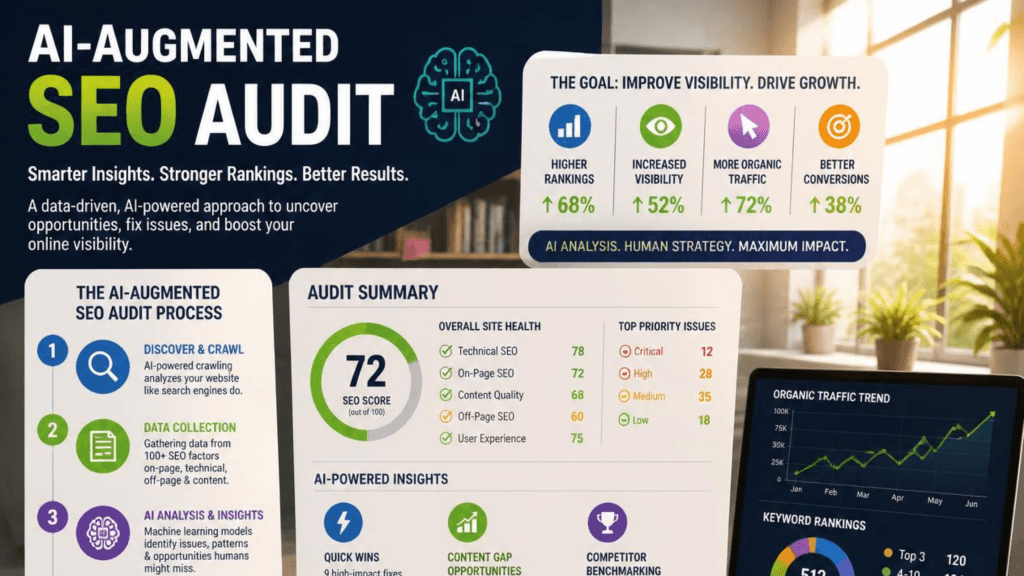
Most businesses have had an SEO audit done at some point. Someone ran a crawler, flagged broken links and missing meta descriptions, checked page speed, maybe glanced at backlinks, and handed over a PDF full of recommendations. That process still has value. But if it’s the whole story, it’s missing an increasingly important half of the picture: how AI systems are actually seeing, parsing, and citing (or not citing) your content.
That gap is exactly what an AI-augmented SEO audit is built to close. It’s not a replacement for traditional technical auditing; it’s an extension of it, built around the reality that a growing share of search visibility now happens inside AI-generated answers rather than traditional blue links.
Why the Old Audit Model Is Incomplete
Here’s the shift in plain terms. Google’s AI Overviews now appear across a substantial and rapidly growing share of search queries, with some 2026 trackers placing coverage as high as 48% to 60% depending on query type, up sharply from under a third just a year earlier, according to data compiled in Memeburn’s 2026 Google AI Overview statistics report. At the same time, click-through rates on traditional organic results, even position one, have dropped meaningfully when an AI Overview appears, with some field studies showing declines in the range of 34 to 60%.
A traditional audit tells you whether your site can rank. It doesn’t tell you whether your content is structured in a way that gets pulled into the AI-generated answer sitting above those rankings, or whether an AI platform like ChatGPT or Perplexity would cite you at all if someone asked it a relevant question. That’s a real blind spot, and it’s growing every quarter.
What an AI-Augmented SEO Audit Actually Covers
Traditional technical fundamentals, still first. This part doesn’t go away. Site speed, mobile usability, crawlability, indexation issues, broken internal links- these remain foundational. AI systems fetching your content need clean, accessible pages just as much as human visitors and traditional crawlers do. Skipping this step and jumping straight to “AI optimization” is a mistake some agencies make when chasing trendy terminology.
Structured data audit. This is one of the biggest gaps most sites have. A proper audit checks whether your pages have accurate, complete schema markup Organization, Article, Product, LocalBusiness, FAQ, and whether that markup actually matches the visible content on the page (mismatched schema can do more harm than good). This matters because pages with properly structured data are roughly 2.5 times more likely to appear in AI-generated answers, according to research summarized by BloggersIdeas’ 2026 schema markup statistics. Separate research referencing a Princeton University study on generative engine optimization found that combining structured data with authoritative citations and clear statistics produced meaningfully higher AI citation rates, per ITXIT Pro’s 2026 coverage.
Content clarity and answer-first structure. An AI-augmented audit evaluates whether your key pages actually answer the questions people are asking, clearly and near the top of the content, rather than burying the useful information under paragraphs of preamble. AI systems tend to favor directly citable content, meaning a clear, self-contained statement or answer they can pull without needing to paraphrase heavily.
E-E-A-T signal review. This means checking for real author attribution, verifiable credentials where relevant, consistent entity information across your site and third-party mentions, and genuine first-hand expertise reflected in the writing. Generic, unsourced content is exactly the kind of thing AI systems are getting better at deprioritizing.
Current AI visibility baseline. A thorough audit actually tests where you stand today, running relevant queries through Google’s AI Overviews, ChatGPT, and Perplexity to see whether your business shows up, gets cited, or is nowhere to be found. This gives you a real starting point, rather than guessing.
Citation overlap analysis. Since AI Overview citations correlate strongly with traditional organic rankings, growing from roughly a third overlap to over half in the past year according to BrightEdge data referenced in SQ Magazine’s report, a good audit looks specifically at which of your pages are close to ranking well enough to start showing up in AI citations too, and what’s holding them back.
Competitor AI visibility check. Just as useful as auditing your own site is checking who’s currently getting cited for your target queries and why. Sometimes the gap between you and a competitor showing up in an AI answer comes down to something as fixable as missing schema or a poorly structured FAQ section.
What You Should Walk Away With
A genuinely useful AI-augmented SEO audit doesn’t just hand you a list of problems; it gives you a prioritized roadmap. Not every fix carries equal weight. Structured data gaps and content clarity issues on your highest-intent pages typically deserve attention before smaller technical tweaks that won’t move the needle much on their own.
It’s also worth setting realistic expectations here. An audit can meaningfully improve your odds of AI citation; it can’t guarantee it. Nobody, including the SEO agencies running these audits, controls exactly how Google’s AI Overviews or ChatGPT decide what to cite on any given day. What a solid audit does is remove the obvious, fixable reasons you might be getting skipped over.
Why This Is Worth Doing Now, Not Later
The businesses getting cited inside AI-generated answers are seeing real, measurable performance advantages, roughly 120% higher click-through rates per impression compared to uncited competitors on identical queries, according to Seer Interactive research cited in SQ Magazine’s 2026 data. And traffic referred from AI platforms tends to convert at notably higher rates than standard organic search traffic, according to tracking from Everwilde One’s AI search statistics page. That’s not a small gap, and it tends to compound in favor of businesses that establish topical authority and clean technical structure early.
Meanwhile, overall investment in SEO isn’t slowing down. Global SEO services spend is estimated at over $80 billion in 2026, according to figures reported by Yahoo Finance’s SEO statistics roundup, which suggests businesses broadly see this as a growing, evolving investment rather than a channel to abandon.
How the Process Usually Unfolds
A well-run AI-augmented audit typically moves through a few distinct phases rather than happening all at once. First comes the technical crawl, the same foundational check any solid audit starts with, covering indexation, speed, mobile usability, and broken links or redirects. From there, the structured data review examines what schema currently exists, whether it’s implemented correctly, and where it’s missing entirely on key pages. Next is the AI visibility baseline, actually testing relevant queries across Google’s AI Overviews, ChatGPT, and Perplexity to see where your business currently stands.
After that, the content and E-E-A-T review looks at whether your key pages answer questions clearly, whether authorship and expertise signals are strong and consistent, and whether the content demonstrates real, specific knowledge rather than generic filler. Finally, a competitive comparison shows where competitors are winning AI citations you’re not, and what specifically seems to be driving that gap.
The output should be a prioritized action plan, not just a list of problems. Not every issue carries equal weight, and a good audit tells you clearly what to fix first for the biggest impact, rather than leaving you with fifty equally-weighted line items and no sense of where to start.
How Often Should You Re-Audit?
This isn’t a one-and-done exercise. Given how quickly AI search platforms are evolving, quarterly check-ins on your AI visibility baseline are reasonable for competitive industries, with a more comprehensive full audit annually or whenever you make significant changes to your site structure or content strategy. Businesses in slower-moving, less competitive categories can generally stretch that timeline out further, but nobody should be running on an audit from two or three years ago at this point; the landscape has shifted too much.
Frequently Asked Questions
How is an AI-augmented audit different from a regular technical SEO audit?
It includes everything a traditional audit covers: technical health, site structure, indexation, plus an additional layer specifically evaluating structured data quality, content citability, and actual visibility across AI Overviews and AI chat platforms.
Do I need this if my site already ranks well organically?
It’s still worth doing. Strong organic rankings correlate with AI citation likelihood, but they don’t guarantee it. There are often specific, fixable gaps- missing schema, unclear answer structure- that keep an otherwise well-ranking page from getting pulled into AI-generated answers.
How long does an AI-augmented SEO audit typically take?
Depending on site size and complexity, a thorough audit usually takes a few weeks to complete properly, factoring in the AI visibility testing phase, which benefits from testing across multiple query variations rather than a single quick check.
What happens after the audit is complete?
The audit itself is a diagnostic step, not the fix. The real value comes from actually implementing the prioritized recommendations, then tracking whether AI visibility and traditional rankings improve over the following months.
How to Measure Whether It’s Actually Working
An audit is only useful if you track whether the resulting changes move the needle. That means setting up measurement before you start implementing fixes, not after. A few things worth tracking consistently: traditional keyword rankings for your priority terms, sure, but also periodic manual checks of whether your business appears in AI Overviews, ChatGPT responses, and Perplexity answers for those same terms. Referral traffic segmented by source, so you can see specifically how much traffic is arriving from AI platforms versus traditional search, and how that traffic converts compared to your other channels. Click-through rate trends on pages that received structured data or content updates, watching for the kind of lift that studies have associated with proper schema implementation. And overall lead quality and volume, since visibility gains only matter if they translate into actual business outcomes.
It’s worth being patient here. A single month of data rarely tells you much, given how AI platforms are still refining their own citation logic. Three to six months of consistent tracking gives you a much clearer picture of whether the audit’s recommendations actually moved your numbers, and where further adjustment might be needed.
Bringing It Together
An AI-augmented SEO audit isn’t a gimmick layered on top of a normal audit to justify a higher invoice. Done properly, it’s a genuinely more complete picture of where your business stands in a search landscape that now includes AI-generated answers as a major, growing piece of the puzzle. Skipping this layer of analysis means making decisions with an incomplete map, and in a search environment changing this quickly, that’s a real competitive disadvantage.
Digital Drew SEM builds AI visibility analysis directly into its standard SEO audit process, covering technical fundamentals, structured data, and AI citation potential as one connected review rather than a bolt-on add-on. If your last SEO audit predates the AI Overview era, and for most businesses, that’s more common than not, it’s probably worth a fresh look before your competitors get there first.
One last thing worth remembering here: an audit is a snapshot, not a permanent verdict. The businesses that benefit most from this process treat it as the start of an ongoing relationship with their own data, revisiting it, adjusting, and staying honest about what’s actually moving the needle versus what just sounds good in a strategy deck. That mindset, more than any single tactic on the checklist, tends to be what separates the sites that stay visible as search keeps changing from the ones that quietly fall behind.
It’s easy to treat an audit as a chore, a box to check before the “real” marketing work starts. In practice, it’s the opposite. Every structural fix, every schema correction, every rewritten page that finally answers the question clearly, is real marketing work, arguably some of the highest-leverage marketing work a business can do, since it keeps paying off quietly in the background long after the audit itself is finished.

Drew Blumenthal is the founder and CEO of Digital Drew SEM, a results-driven, performance-focused digital marketing agency based in New York. With deep expertise in Google Ads, Meta advertising, SEO, website development, and social media management, Drew combines creative strategy with analytical precision to deliver measurable growth. He frequently shares insights on performance marketing, digital trends, and scalable strategies for business growth.