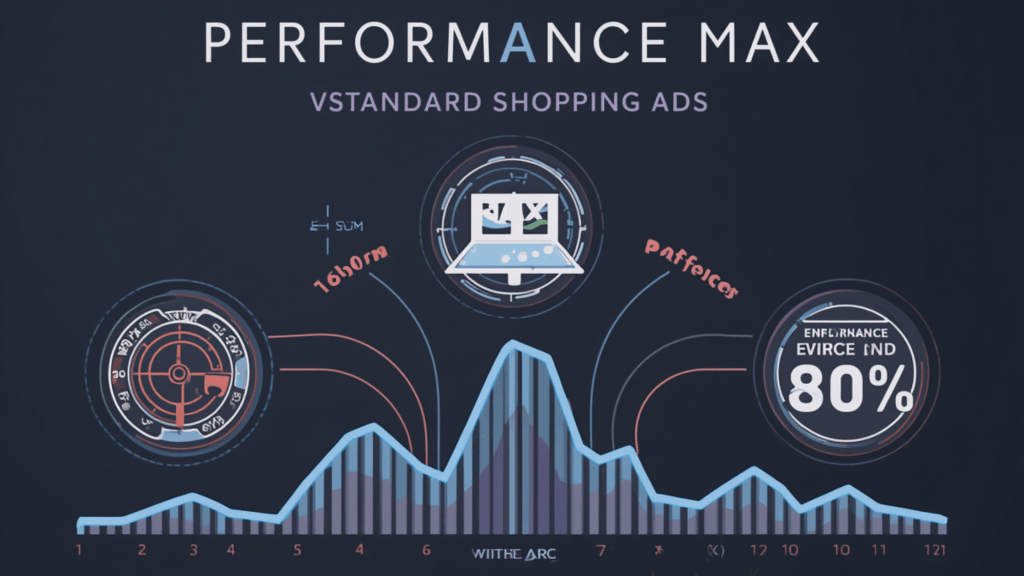
The Performance Max vs Standard Shopping debate is the most important campaign structure decision ecommerce brands face in 2026 — and most of them are getting it wrong in one of two directions: either running Performance Max and treating it like a self-managing campaign, or abandoning PMax entirely and leaving cross-channel reach on the table.
The right answer is neither. The most profitable ecommerce Google Ads accounts in 2026 run both campaign types in a deliberate structure. Here’s what that structure looks like, when each type wins, and what to do if your current campaign mix isn’t generating profitable ROAS.
What Performance Max Actually Does (and What It Doesn’t)
Performance Max is Google’s AI-driven campaign type that serves ads across every Google surface simultaneously: Search, Shopping, Display, YouTube, Gmail, and Discover, all from one campaign. For ecommerce brands, Shopping placements are typically the highest-performing surface within PMax, but the cross-channel reach means your product ads can appear in contexts Standard Shopping can’t access.
What PMax does not do: give you visibility into search terms, let you control individual product bids directly, or tell you which placements are driving your conversions. It’s a black box that works well when you feed it well and fails quietly when you don’t.
What Standard Shopping does: gives you direct control over product groups, individual bids, negative keywords, and full search term visibility. For advertisers who need to manage by margin, promoting high-margin products more aggressively, pulling back on low-margin items — Standard Shopping is the only campaign type with the precision to do that.
The 2026 Data Reality on Performance Max for Ecommerce
Performance Max averages approximately 2.57:1 ROAS across ecommerce accounts compared to Standard Shopping’s approximately 5.17:1. That number surprises most people who’ve been told PMax is the future of ecommerce advertising.
The gap exists because PMax optimizes for Google’s objectives (broad reach, high spend, automated bidding), which don’t always align with your objective (profitable margin at efficient ROAS). PMax left to manage itself will find that it’s very good at that. It will be spent on low-intent Display placements, brand searches that would have converted anyway, and broad audience signals that dilute your Shopping performance.
The accounts where PMax outperforms have one thing in common: active management by someone who understands how to guide the automation rather than just let it run.
When Standard Shopping Wins Over Performance Max
Standard Shopping should be your primary campaign structure when:
You have a catalog of under 50 products. With a smaller catalog, you can manage product groups precisely in Standard Shopping, segment by margin, and run tightly controlled bids. The automation advantage of PMax is less valuable when you can manage the catalog manually without significant overhead.
You need search term data. Standard Shopping shows you what search queries are triggering your ads. That visibility is critical for adding negative keywords, identifying low-intent traffic, and understanding what language your buyers use. PMax doesn’t give you this.
Your margins vary significantly across products. If Product A has a 60% margin and Product B has a 20% margin, you need different ROAS targets for each. Standard Shopping lets you segment and bid accordingly. PMax manages the catalog as a single bidding unit.
You’re in the first 30–60 days of running Google Ads. PMax needs conversion history to optimize. Without that data, it will spend randomly while it “learns.” Standard Shopping with manual CPC gives you control while you build the historical data PMax needs to work effectively.
When Performance Max Wins
Performance Max is the right tool when:
You have a large catalog (50+ products) and a strong conversion history. PMax’s automation scales across large product sets in ways Standard Shopping can’t manage manually. With 6+ months of conversion data feeding the algorithm, PMax can identify buying signals you’d never catch manually.
You want YouTube and Discovery reach. If your products benefit from visual advertising beyond Shopping placements, branded merchandise, lifestyle products, and visually distinctive items, PMax is the only campaign type that puts Shopping ads alongside YouTube and Discover automatically.
You’ve exhausted Standard Shopping’s ceiling. When your Standard Shopping campaigns are hitting budget limits and ROAS is stable, PMax can expand your total reach without cannibalizing your existing Shopping performance if it’s structured correctly.
The Hybrid Structure That Outperforms Both
The highest-performing ecommerce Google Ads accounts in 2026 run a deliberate hybrid:
Standard Shopping handles precision. Your top-margin products, your brand terms, your highest-converting categories — these live in Standard Shopping with tightly managed bids and aggressive negative keyword lists. You control the budget, you see the search terms, you manage the margin.
Performance Max handles scale. Your broader catalog, new customer acquisition, and cross-channel reach live in PMax. Asset groups are organized by product category. Audience signals pull from your customer list and site visitors. Brand terms are excluded from PMax to prevent cannibalization of your Standard Shopping brand campaigns.
The critical detail most accounts get wrong: PMax and Standard Shopping will compete against each other in Google’s auction if you don’t structure them carefully. Without proper campaign priorities and negative keyword lists applied to PMax, you’ll end up with both campaigns bidding on the same searches, increasing your own costs and diluting performance data.
Signs Your Current Campaign Structure Needs to Change
Your ROAS dropped when you switched to Performance Max. This is common and fixable. The issue is usually that PMax is spending on low-intent placements (Display, YouTube) without brand exclusions or audience signals that focus it on buyers. The fix involves restructuring asset groups, adding brand exclusions, and uploading your customer list as an audience signal.
Your Performance Max campaign spends heavily but converts poorly. PMax is finding reach, that’s what it’s designed to do. Without conversion data to guide it, it defaults to impressions over intent. If conversion tracking isn’t properly set up (purchase events, revenue values), PMax has no signal to optimize toward profit.
You haven’t touched your Standard Shopping campaigns since launching PMax. Standard Shopping doesn’t self-optimize. If you launched PMax and deprioritized your Standard Shopping campaigns, you’ve likely lost the precision that was making your catalog profitable.
Your Merchant Center feed hasn’t been updated in months. Performance Max optimization is 70% feed quality. Title structure, product categorization, custom labels for margin segmentation, if the feed is stale, PMax can’t perform.
What a Properly Managed Ecommerce Google Ads Account Looks Like
A well-structured ecommerce account in 2026:
- Standard Shopping campaigns segmented by margin tier or product category
- Performance Max with one asset group per product category (not one giant campaign covering everything)
- Brand campaigns running separately in Search to protect branded ROAS
- Negative keyword lists pushed to PMax to prevent cannibalization
- Customer match audiences loaded as PMax signals
- Merchant Center feed reviewed and updated at a minimum monthly frequency
- Separate ROAS targets set by campaign based on product margin, not a single ROAS target across the whole account
This structure takes time to build and requires active management to maintain. An ecommerce brand spending $5,000/month on Google Ads without this architecture in place is almost certainly leaving significant ROAS on the table.
Frequently Asked Questions
Should ecommerce brands use Performance Max or Standard Shopping in 2026?
Both. The most profitable ecommerce accounts in 2026 run a hybrid: Standard Shopping for precision, margin-segmented bidding, and search term visibility; Performance Max for cross-channel reach and large catalog automation. Running PMax alone sacrifices the control you need to manage profitably. Running Standard Shopping alone leaves YouTube and Discovery reach on the table. The question is how to structure both so they don’t compete against each other.
Why is my Performance Max ROAS lower than my Shopping ROAS?
Performance Max serves across all Google surfaces, including Display and YouTube, which have lower purchase intent than Shopping placements. Without brand exclusions and strong audience signals, PMax defaults to broad reach rather than high-intent buyers. The fix is to restructure your PMax campaign with tighter audience signals, exclude brand terms, and segment asset groups by product category so the algorithm has focused inputs rather than a catch-all catalog.
Can I run Standard Shopping and Performance Max at the same time?
Yes, and you should. The key is preventing them from bidding against each other. Apply brand keyword exclusions to your PMax campaigns so they don’t cannibalize your branded Search and Shopping terms. Set Standard Shopping campaigns to a higher priority for your top-performing product categories. This lets each campaign type do what it does best without internal competition.
How long does it take Performance Max to optimize for ecommerce?
Google recommends a 6-week learning period for PMax before drawing conclusions. In practice, accounts with strong conversion history (1,000+ conversions in the last 30 days) see PMax stabilize faster. Accounts with thin conversion data will see PMax spending erratically while the algorithm learns. If you’re early in building conversion volume, Standard Shopping with manual CPC is a better starting structure.
What is the biggest mistake ecommerce brands make with Performance Max?
Treating it as a set-and-forget campaign. PMax requires active management: weekly Merchant Center feed reviews, monthly asset refresh (new images, new ad copy angles), ongoing audience signal updates as your customer list grows, and regular ROAS monitoring by campaign. Brands that launch PMax and check it monthly are almost always leaving performance on the table.
What’s the right Google Ads budget for an ecommerce brand using Performance Max?
Performance Max needs enough daily spend to generate conversion data for the algorithm to learn. At minimum, your daily budget should be 10–15x your target cost per acquisition. If you’re targeting a $50 CPA, your daily budget should be at least $500–$750 for PMax to learn effectively. Below that threshold, PMax will spend the budget but generate limited data for optimization. Standard Shopping campaigns can be run profitably at lower daily budgets with more manual management.
How do I know if my ecommerce Google Ads campaigns need a professional manager?
If your ROAS is below 3:1 on Shopping campaigns with established conversion history, if your Performance Max campaigns are spending without profitable attribution, if your Merchant Center feed is generating disapprovals you haven’t addressed, or if you’re not sure whether your conversion tracking is accurately capturing revenue, these are the signals that professional management would recover more than it costs.

Drew Blumenthal is the founder and CEO of Digital Drew SEM, a results-driven, performance-focused digital marketing agency based in New York. With deep expertise in Google Ads, Meta advertising, SEO, website development, and social media management, Drew combines creative strategy with analytical precision to deliver measurable growth. He frequently shares insights on performance marketing, digital trends, and scalable strategies for business growth.