
Keyword Strategy Agency in New York Target What People Actually Search, Not What You Assume They Do.
Most businesses build their keyword strategy around guesswork, whatever term sounds right in a meeting. Meanwhile the tool everyone leans on to validate those guesses isn't as reliable as it seems. Google Ads Keyword Planner overestimates search volume 54.28% of the time, and is only roughly accurate the rest of the time. Building a strategy on inflated numbers means chasing keywords that never had the traffic you thought they did.
We're a keyword strategy agency built around real search behavior, not assumptions. Search intent has also gotten more layered than it used to be. A single keyword often hides multiple distinct intents, and increasingly, people are typing full questions instead of short phrases, especially when they're searching through AI tools instead of a traditional search bar.
Free keyword audit
We review your current rankings, keyword gaps against competitors, and where your existing pages are targeting the wrong terms entirely. No prep, no pitch.
An honest assessment
Three specific gaps — whether that's missed long-tail opportunities, keyword cannibalization across your own pages, or content built around low-intent terms — and what we'd fix first.
You decide
We're selective about which businesses we take on, and we want you just as confident in us before we build a single page.
15–30 minutes. No commitment. No pitch.

Trusted to Grow Businesses Through Powerful Keyword Strategies










Why Most Keyword Strategies Miss the Mark
The mechanics of search have shifted. People searching through AI tools tend to type in full sentences and questions rather than short keyword fragments, which means a keyword strategy built purely around two- and three-word phrases misses a growing share of how people actually search. At the same time, organic search is still the second-highest traffic channel overall at 29%, so traditional keyword targeting hasn't gone away, it's just gotten layered on top of newer search behavior instead of being replaced by it.

You're targeting keywords based on assumed volume, not verified data
Relying on a single tool's estimate, especially Keyword Planner alone, means building a content strategy on numbers that are wrong more often than they're right. Cross-referencing multiple data sources is the only way to get a realistic picture.

You're ignoring long-tail, question-based searches
Short, high-volume keywords are also the most competitive. Long-tail, intent-specific phrases and full questions carry less individual volume but convert better and face far less competition, especially as AI-driven search rewards content that directly answers a specific question.

Multiple pages on your site are competing for the same keyword
Keyword cannibalization, where two or more of your own pages target the same term, splits your authority instead of concentrating it. Most businesses have no idea this is happening until someone audits the full site.

Your keyword strategy doesn't map to actual buyer intent
Ranking for a keyword that draws browsers instead of buyers looks good on a rank tracker and does nothing for revenue. A real keyword strategy separates informational, navigational, and transactional intent, and prioritizes accordingly.
Full Keyword Strategy, Under One Roof
Same team running your Blog Writing and SEO, so the keywords we research are the exact ones your content and site structure get built around.
Multi-source keyword research
Cross-referencing multiple keyword data sources rather than relying on a single tool's estimate, since individual tools regularly overestimate or underestimate true search volume.
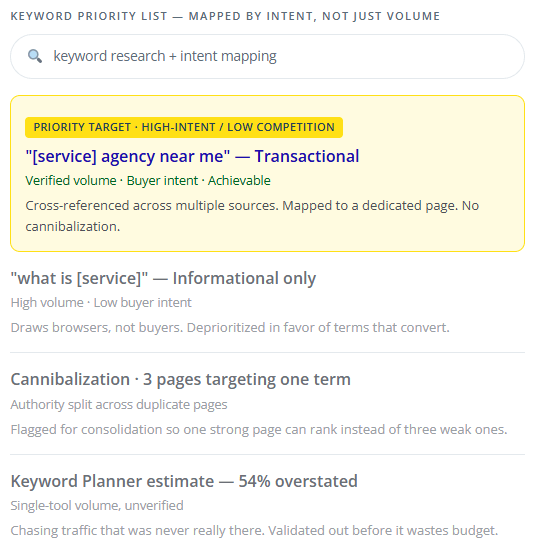
Intent mapping, not just volume chasing
Every keyword classified by intent, informational, navigational, or transactional, so content and page priorities align with what actually drives revenue, not just traffic.
Question-based and long-tail research
Identifying the full-sentence, question-based searches people increasingly use, especially relevant as AI-driven search continues to grow as a discovery channel.
Keyword cannibalization audits
Full-site reviews to identify pages competing against each other for the same terms, with consolidation or differentiation recommendations to fix it.
Competitive keyword gap analysis
Identifying exactly which keywords your competitors rank for that you don't, and prioritizing the ones with the best combination of volume, intent, and achievability.
Topic cluster and site architecture planning
Organizing keyword targets into logical clusters that inform not just content, but overall site structure and internal linking strategy.
How We Build a Keyword Strategy: Research First, Then Prioritize
Nothing gets built until we understand the real opportunity, not just what sounds like a good keyword.
Current rankings and competitor gap audit
We review what you currently rank for, identify cannibalization issues, and map exactly which keywords competitors own that you don't.
→Intent-mapped keyword priority list
You see the full plan — prioritized keywords by intent, volume, and achievability — before any content or site structure decisions get made.
→Implement and refine monthly
Keyword targets get built into content and page strategy, with ongoing tracking and refinement as rankings shift and new opportunities emerge.
Five Steps to a Keyword Strategy Built on Real Data.
Free keyword audit
Current rankings, cannibalization risk, and competitor keyword gaps reviewed together. Yours to keep regardless of what happens next.
Multi-source research and intent mapping
A written plan covering priority keywords cross-referenced across multiple data sources, classified by search intent.
Site architecture and content mapping
Keyword targets mapped to specific pages and content pieces, with cannibalization issues flagged for resolution.
Implementation begins
Content and page optimization built around the finalized keyword strategy, with tracking set up from day one.
Reporting tied to ranking movement and intent match
A monthly call and a one-page report showing ranking progress by keyword priority tier, not just a raw list of positions.
What a Real Keyword Strategy Looks Like
Ranking keyword count, 90-day trend
Ranked keyword count and quality climbing as cannibalization gets resolved and content targets shift toward validated, intent-matched terms.
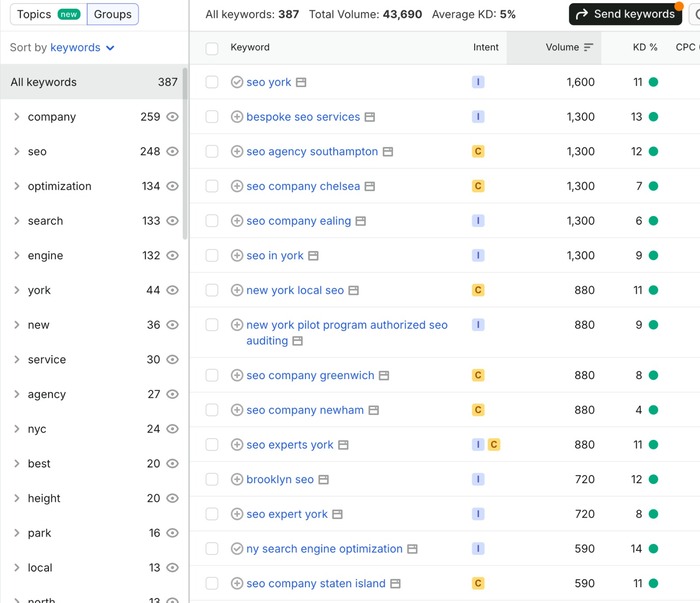
Before vs. after keyword strategy overhaul
A real overhaul replaces guesswork with validated targets, resolves keyword conflicts, and maps every keyword to intent — stronger, more qualified rankings from the same site.
Real SEO Results Built on Strong Keyword Strategy
Every business is different — here’s how strategic keyword research has helped businesses target the right searches, improve rankings, and drive qualified traffic.

Fishman’s Fabrics

Make It Cute Kids

Ventura Law
What Business Owners Say About Working With Us
From local businesses to growing brands — here’s what a real keyword strategy partnership looks like from the other side.

Drew and his team have been a pleasure to work with! Very knowledgeable on SEO and management of PPC campaigns. Thanks Drew and team!

Digital Drew has been fantastic. He made changes with both google clicks and SEO. Both showed positive result within two months. Drew has a great handle on what works. I highly recommend him.

Drew Blumenthal is fantastic! His knowledge, understanding of our needs and in-depth analysis of our SEO was nothing but impressive. Drew explained SEO and the impact of being #1 in Google. He got us up and running, while we concentrated on running our business. If you want more business, call Digital Drew SEM!

Drew Blumenthal is fantastic! If you need help with SEO/Google Rankings. He's the perfect person to speak too.
Digital Drew SEM vs the Alternatives
| What You Get | ⭐ Digital Drew SEM | Typical SEO Agency | In-House / DIY |
|---|---|---|---|
| Multi-source keyword validation | ✓ Standard | ⚠ Single tool reliance | ✕ Guesswork |
| Intent classification for every keyword | ✓ Included | ⚠ Sometimes | ✕ Rarely done |
| Cannibalization audits | ✓ Included | ⚠ Sometimes | ✕ Rarely caught |
| Question-based & AI-search keyword research | ✓ Standard | ⚠ Rarely offered | ✕ Not addressed |
| Keyword strategy tied to content & site architecture | ✓ Yes | ⚠ Usually siloed | ✕ Rarely coordinated |
| Reporting by priority tier, not just raw rank list | ✓ Yes | Vanity metrics PDF | ✕ Manual & slow |
Straight Talk on What Keyword Strategy Costs
We scope the engagement to your site size and competitive landscape on the audit call. A small local site needs a very different research depth than a large multi-category site with cannibalization risk across dozens of pages. Transparent monthly retainer, no inflated promises.
Foundational keyword strategy
Core keyword research and intent mapping for your priority service and category pages, with an initial cannibalization check.
Full-site strategy & ongoing refinement
Comprehensive site-wide keyword architecture, ongoing cannibalization monitoring, and ongoing refinement as search behavior and competition shift.

Why I Don't Trust a Single Keyword Tool
I built Digital Drew SEM after years running marketing for Fortune 500 companies and leading agency teams at IPG Mediabrands and Performics, and keyword research is one of the areas where I've watched businesses get burned the most by convenient shortcuts. Pull one report from one tool, build a content calendar around it, and never question whether the volume numbers were even close to accurate.
Real keyword strategy takes more legwork than that, cross-referencing sources, understanding intent, watching how search behavior itself keeps shifting as more people search through AI tools instead of a search bar. I wrote about staying rigorous rather than convenient in my book on AI and digital marketing, and keyword research is one of the clearest places that discipline pays off, since it's the foundation every other SEO decision gets built on.
I'm personally in these accounts. If we're not the right fit for your business, I'll tell you on the call.
How AI Search Is Reshaping Keyword Research
Keyword research used to mean short phrases and search volume tiers. That's changing as more people search conversationally through AI tools, asking full questions instead of typing fragmented phrases. A keyword strategy that only accounts for traditional short-tail terms is increasingly missing a growing slice of real search behavior.
The businesses adapting well build keyword strategies that cover both worlds — the concise, high-volume terms that still drive traditional search, and the longer, question-based phrasing that AI-driven search increasingly rewards.
Traditional keyword SEO becomes one input into a broader strategy, not the whole picture on its own.
Book My Free Keyword Audit →Short-Tail + Question-Based Coverage
A keyword plan that covers both the concise, high-volume terms traditional search still rewards and the full-sentence questions AI-driven search increasingly favors.
Conversational Query Readiness
Targeting the full questions people now type into AI tools instead of fragmented two- and three-word phrases, so you're visible where search is heading.
Intent Over Raw Volume
Every term classified as informational, navigational, or transactional, so effort concentrates on keywords that actually drive revenue, not just traffic.
Multi-Source Validation
Volume cross-referenced across multiple data sources rather than trusting a single tool's estimate, which is wrong more often than it's right.
Questions Businesses Ask About Keyword Strategy
We cross-reference multiple keyword research sources rather than relying on any single tool, since individual platforms like Google's own Keyword Planner are known to overestimate volume a majority of the time. Triangulating across sources gives a far more realistic picture.
It's when two or more pages on your own site target the same or very similar keywords, splitting the ranking authority that could otherwise concentrate on one strong page. It's more common than most businesses realize and can quietly cap how well any of the competing pages perform.
Both, but strategically. High-volume keywords carry more competition and often less specific intent, while long-tail, question-based keywords convert better and face less competition. A real strategy balances both based on your resources and timeline.
Search behavior and competition shift constantly, so we treat keyword strategy as an ongoing process rather than a one-time project, revisiting priorities monthly as rankings move and new opportunities emerge.
Yes, competitive gap analysis is a core part of what we do, identifying exactly which terms competitors are winning and which of those represent realistic, worthwhile opportunities for you.
Yes, that's exactly what the free audit covers. We review your current rankings, cannibalization risk, and competitor gaps together and show you where the opportunities are, no obligation afterward.
Stop Guessing at What People Are Actually Searching For
Book your free keyword audit. We'll review your current rankings, cannibalization risk, and competitor keyword gaps together, show you the three biggest opportunities, and give you an honest read on what it would take to close them.