The honest answer to “Google Ads vs SEO” is that you shouldn’t have to choose, but most businesses do have to start somewhere. This guide breaks down exactly what each channel delivers, what it costs, how long it takes, and which one belongs in your strategy first based on where your business actually is right now.
At Digital Drew SEM, we run both Google Ads and SEO for clients across industries. The answer is almost never “pick one”, but the starting point matters enormously, and getting it wrong costs real money.
What Is the Core Difference Between Google Ads and SEO?
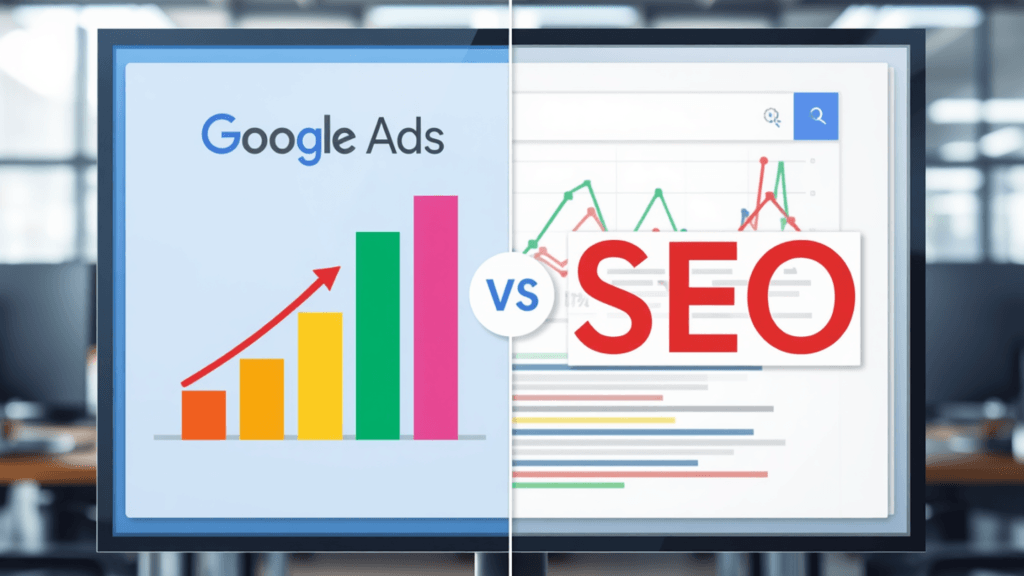
Google Ads is paid search; you pay Google each time someone clicks your ad. Your listing appears at the top of search results immediately, but the moment you stop paying, you disappear.
SEO (Search Engine Optimization) is organic search; you earn your position in the non-paid results by building the authority, relevance, and technical health of your website. It takes time to build, but once you rank, the traffic is essentially free and compounds over time.
That one distinction, rented vs. owned traffic, drives almost every other difference between the two channels.
Google Ads: What It Delivers and What It Costs
What Google Ads Does Well
Immediate results: Campaigns can go live in 24-48 hours. Traffic starts the day your ads launch.
Precise targeting: You choose exactly which keywords trigger your ads, which locations see them, what time of day they run, and which device types get which bids.
Measurable ROI: Every click, conversion, and dollar spent is tracked. You know exactly what your cost per lead or cost per sale is.
Budget control: You set a daily maximum. You can scale up when it’s working and pause when it isn’t.
Intent targeting: People searching for “personal injury lawyer NYC” are actively looking to hire. Google Ads puts you in front of them at the exact moment of intent.
What Google Ads Doesn’t Do
It stops the moment you stop paying. No budget, no traffic. There is no equity built.
It gets expensive in competitive industries. Legal, finance, and insurance keywords can cost $20-$150+ per click. SaaS and e-commerce are increasingly expensive.
It requires constant management. Google Ads left unmanaged will waste budget through irrelevant searches, poor bidding, and campaign drift.
Who Should Prioritize Google Ads First
– Businesses that need leads or sales now, new businesses, businesses entering a new market, businesses with seasonal demand
– Industries where the buying cycle is short, and intent is high (legal, home services, healthcare, e-commerce)
– Businesses with an established website and conversion path, ads drive traffic, but the site closes the deal
– Companies testing a new offer before investing in long-term SEO
SEO: What It Delivers and What It Costs
What SEO Does Well
Compounding returns: Unlike paid ads, every piece of content and every earned link builds permanent authority. A page that ranks today can bring traffic for five years.
Credibility: Organic rankings carry inherent trust signals that paid ads do not. Many buyers skip the ads and click organic results specifically because they don’t trust paid placements.
Lower long-term cost per acquisition: Once ranked, organic traffic has no per-click cost. For businesses in it for the long term, the ROI on well-executed SEO is typically higher than paid search over a 2-3 year horizon.
AI search visibility: Google AI Overviews, ChatGPT, Gemini, and Perplexity all pull from organic content, not paid ads. SEO is the foundation for being cited in AI-generated answers.
Brand authority: Ranking organically for competitive terms establishes market authority in a way that paid ads simply cannot.
What SEO Doesn’t Do
It doesn’t produce immediate results. Depending on your domain authority and the competitiveness of your keywords, SEO takes 3-12 months to produce measurable ranking movement. In highly competitive spaces, longer.
It requires sustained investment. Content, technical optimization, and link building are ongoing, not a one-time project.
It’s uncertain. Google’s algorithm updates can affect rankings regardless of how well your SEO is executed. A manual penalty or a core update can alter organic performance overnight.
Who Should Prioritize SEO First
– Businesses with a medium-to-long sales cycle where buyers research extensively before deciding
– B2B companies, SaaS businesses, and professional services where thought leadership compounds authority
– Businesses with existing traffic that can be converted better through content and UX improvements
– Brands building for 3+ year time horizons who want to reduce dependence on paid advertising
Google Ads vs SEO: Head-to-Head Comparison
| Factor | Google Ads | SEO |
| Time to results | Days | 3-12 months |
| Cost structure | Pay per click | Time + content investment |
| Traffic durability | Stops when budget stops | Compounds over time |
| Intent targeting | Very precise | Keyword and topic-based |
| AI search visibility | No | Yes |
| Trust signal | Lower (labeled as ad) | Higher (earned position) |
| Measurability | Immediate and precise | Longer attribution window |
| Scalability | Limited by budget | Limited by domain authority |
| Best for | Fast growth, high intent | Long-term authority, lower CPA |
The Strategy Most Businesses Miss: Running Both Together
The businesses getting the best ROI from search in 2026 aren’t choosing between Google Ads and SEO; they’re using them to complement each other.
Google Ads delivers while SEO builds. In the short term, Google Ads produces the leads and revenue that fund operations while your SEO strategy compounds in the background. In 12-18 months, organic traffic starts to reduce your dependence on paid spend, and your cost per acquisition drops.
Google Ads data informs your SEO strategy. The keywords that convert in your paid campaigns are your highest-value SEO targets. You know they have buyer intent because you’ve already paid to test them.
SEO reduces your Google Ads costs over time. The stronger your overall domain authority and content depth, the better your Google Ads Quality Scores tend to be, which directly lowers your cost per click.
At Digital Drew SEM, we manage both channels for clients across industries. The most efficient client accounts are ones where paid and organic are working from the same strategy, not running as two separate, disconnected efforts.
How Much Does Each Channel Cost?
Google Ads: You pay for each click. In competitive industries, clicks range from $2-$5 (e-commerce, local services) to $20-$150+ (legal, financial services, insurance). A typical small business Google Ads budget ranges from $1,500-$10,000/month in ad spend, plus management fees.
SEO: The investment is in time, content, and expertise, not clicks. A professional SEO retainer ranges from $1,500-$5,000/month for most small-to-mid-size businesses. The return on that investment grows over time, unlike paid ads, where the ROI is relatively constant.
Which Should You Start With?
Start with Google Ads if:
– You need revenue within 30-90 days
– Your website is already optimized and converts traffic well
– You’re in a high-intent industry (legal, home services, healthcare, e-commerce)
– You’re testing a new market or offer
Start with SEO if:
– Your timeline is 6-12+ months
– You’re in a B2B or professional services space where buyers research deeply before deciding
– You want to reduce long-term cost per acquisition
– You’re building a content-led business model
Start with both if:
– You have the budget to invest in both channels simultaneously
– You want to dominate your market, not just participate in it
– You’re working with an agency that can run both from the same strategy
Frequently Asked Questions: Google Ads vs SEO
Is Google Ads better than SEO for getting quick results?
Yes, for speed, Google Ads is unmatched. Campaigns can go live within 24-48 hours and start driving traffic immediately. SEO typically takes 3-12 months before you see meaningful ranking movement, depending on your industry competitiveness and your domain’s existing authority. If you need leads or sales in the next 30-90 days, Google Ads is the right channel to start with. That said, Google Ads traffic stops the moment your budget stops, while SEO builds equity that compounds over time.
Which has a better ROI, Google Ads or SEO?
It depends on the time horizon. In the short term (0-12 months), Google Ads typically delivers clearer, faster ROI because you can see exactly what each click costs and what each conversion produces. Over a 2-5 year horizon, well-executed SEO usually produces a lower cost per acquisition because organic traffic has no per-click cost. The best ROI typically comes from running both channels in coordination; Google Ads generates revenue while SEO compounds in the background.
Can Google Ads help my SEO?
Google Ads do not directly improve your organic rankings; Google is explicit that paid spend does not influence organic position. However, Google Ads data indirectly informs better SEO decisions: the keywords that convert in your paid campaigns are your highest-value organic targets. Running ads also builds brand familiarity, which can improve click-through rates when your brand appears in organic results. Digital Drew SEM uses paid search data to prioritize SEO content strategy for every client running both channels.
How much does Google Ads cost compared to SEO?
Google Ads costs are driven by your industry’s keyword competition. E-commerce and local services keywords might run $2-$10 per click; legal and financial services keywords often run $30-$150+ per click. SEO is an investment in expertise and content, typically $1,500-$5,000/month for a professional retainer, but the traffic earned has no per-click cost. Over 2-3 years, businesses with strong SEO usually have a significantly lower blended cost per acquisition than those relying exclusively on paid search.
Should a new business start with Google Ads or SEO?
Most new businesses should start with Google Ads. A new website with no domain authority cannot rank organically for competitive terms in a meaningful timeframe; it needs to earn authority first. Google Ads bypasses that by putting you in front of high-intent buyers immediately. As your business generates revenue from paid search, invest a portion of that into building your SEO foundation, content, technical optimization, and link building, so that in 12-18 months, your organic traffic begins to supplement paid.
Does SEO still work in 2026 with AI search engines?
SEO is more important in 2026 than it has ever been, specifically because of AI search. Google AI Overviews, ChatGPT, Gemini, Perplexity, and Claude all pull answers from indexed organic content, not paid ads. A business that ranks organically for relevant queries is far more likely to be cited in AI-generated responses than one that relies solely on paid ads. At Digital Drew SEM, we build SEO strategies that target both traditional Google rankings and AI search visibility simultaneously.
How do I know if I need Google Ads, SEO, or both?
The clearest signal is your timeline and your business model. If you need revenue within 90 days, you need Google Ads. If you’re building for 12+ months and have a content-driven business model, SEO is the foundation. If you’re a growth-stage or established brand with a real marketing budget, both channels should be running, just with a clear strategy for how they complement each other. Digital Drew SEM offers free strategy consultations to help businesses map the right channel mix for their specific goals.

Drew Blumenthal is the founder and CEO of Digital Drew SEM, a results-driven, performance-focused digital marketing agency based in New York. With deep expertise in Google Ads, Meta advertising, SEO, website development, and social media management, Drew combines creative strategy with analytical precision to deliver measurable growth. He frequently shares insights on performance marketing, digital trends, and scalable strategies for business growth.