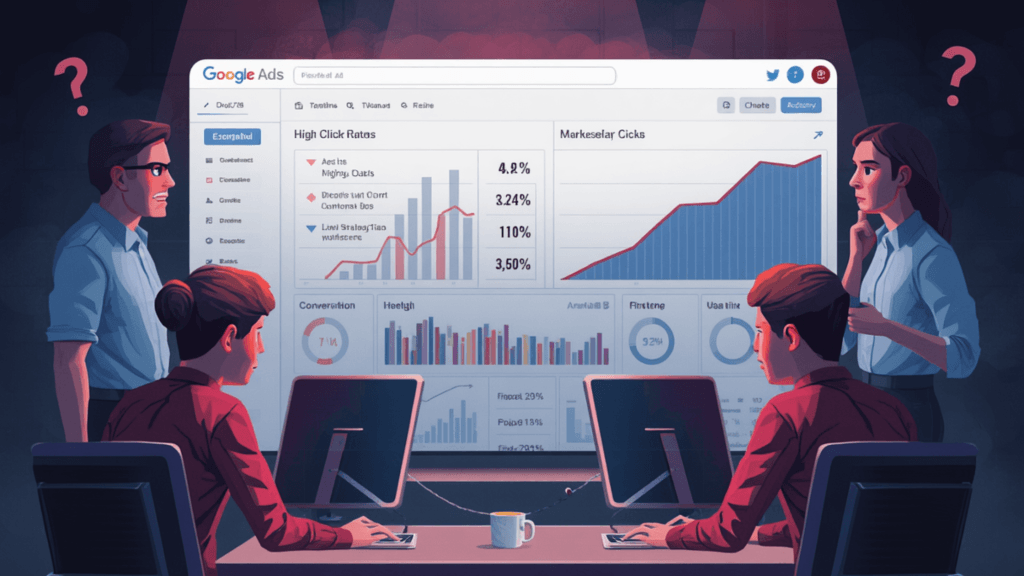
You set a budget. You launched the campaign. The clicks started rolling in, the dashboard lit up green, and for a few days it felt like the machine was finally working. Then you checked the only number that actually pays your salary: sales. Leads. Booked calls. Nothing. Or close to nothing.
That gap, the one between traffic and revenue, is where most ad budgets quietly bleed out.
Here’s the frustrating part. Clicks are easy. Google is very, very good at sending you clicks; it’s the entire business model. Conversions are hard, because a conversion depends on a dozen things that happen after the click, most of which Google neither controls nor cares about. So you can run a technically “healthy” account and still watch money evaporate.
Let’s fix that. Below are nine reasons your traffic isn’t turning into customers, each with a fix you can actually act on this week.
- The short answer first
- 1. Your conversion tracking is broken (or counting things twice)
- 2. Your keywords pull traffic, not buyers
- 3. The landing page doesn’t keep the promise the ad made
- 4. Your page loads too slowly, and people just leave
- 5. Your form asks for too much, too soon
- 6. The mobile experience is an afterthought
- 7. You’re showing ads to the wrong people
- 8. There’s no real offer, just a request
- 9. Your call to action is weak, buried, or confusing
- So which one is killing your account?
- A quick word on who’s writing this
- Where to go from here
The short answer first
Google Ads clicks but no conversions usually comes down to one of three buckets: a tracking problem (the sales are happening but you can’t see them), a traffic-quality problem (you’re paying for the wrong people), or a post-click problem (the landing page, offer, or form is losing them). Almost every account I’ve ever audited falls into at least one of these. Often all three.
For context on what “normal” even looks like: the average Google Ads conversion rate across industries sits around 7%, according to WordStream’s benchmark data. So if you’re converting 2% of clicks, you’re not cursed; you’re just leaking somewhere fixable. And if you’re converting 0%, something is almost certainly broken rather than merely underperforming.
Now the nine causes.
1. Your conversion tracking is broken (or counting things twice)
I’m putting this first on purpose, because it’s the most common and the most embarrassing to discover late.
A huge share of “no conversion” panic isn’t a performance problem at all. The sales are happening. The form fills are landing in someone’s inbox. But the conversion tag never fired, or it fired on the wrong page, or it got wiped out during a site redesign nobody told you about. Google sees zero, so Google optimizes toward zero, and the whole campaign slowly strangles itself chasing a goal it can’t measure.
How to spot it: open Google Tag Assistant or the Google Ads conversion diagnostics and run a real test conversion. Submit your own form. Buy your own product with a test card if you have to. Watch whether the event actually registers, and how long it takes to show up.
Watch for double-counting too. If your thank-you page reloads, or you’ve got the same tag firing through both Google Ads and a Google Analytics import, you might be inflating numbers, which is its own kind of lie. The fix is usually a clean rebuild of your tracking through Google Tag Manager, with one source of truth for each conversion action. Boring work. Pays for itself faster than almost anything else you’ll do.
A quick gut check: if your conversions look too good or impossibly bad, suspect the plumbing before you suspect the strategy.
2. Your keywords pull traffic, not buyers
Here’s a trap Google built into the platform, and most advertisers walk straight into it.
Broad match is now the default match type, which means your ads can show for searches that are only loosely related to what you sell. WordStream flagged this directly in its 2024 benchmark report: broad match quietly stretches your reach toward queries with low commercial intent. Translation? You bid on “running shoes,” and you end up paying for “how to clean running shoes” and “are running shoes bad for your knees.” Curious people. Not customers.
And those clicks aren’t free. The average cost per click in Google Ads ran about $4.66 in 2024 per WordStream, and it’s climbed since. So every low-intent click is real money spent on someone who was never going to buy.
The fix is a two-parter. First, pull your search terms report and read it like a detective. You’ll find horror stories in there. Add the junk as negative keywords; build the list out aggressively. Second, tighten your match types. Phrase and exact match cost a little reach but buy you a lot of relevance, and relevance is what converts.
You might notice your click volume drop after this. Don’t flinch. Fewer, better clicks beat a flood of tire-kickers every single time.
3. The landing page doesn’t keep the promise the ad made
Picture this. Your ad says “50% Off Custom Blinds, Free Install.” Someone clicks, expecting blinds and a deal. They land on your homepage, which talks about your company’s 30-year heritage and has a hero image of a smiling family. Where’s the 50%? Where do they even click?
Gone. They’re gone.
This message-match problem is so common it’s almost the default state of bad campaigns. The ad and the page need to feel like one continuous thought. Same headline, same offer, same language. If the ad sells a free consultation, the page’s job is to make booking that consultation the single most obvious action on the screen.
The fix isn’t fancy. Build dedicated landing pages for your top campaigns instead of dumping traffic onto a generic homepage. One offer, one page, one action. Strip out the navigation that tempts people to wander off. Repeat the offer near the button so nobody has to scroll back up to remember why they came.
This is where a lot of accounts win or lose, honestly. Great ads pointing at a mediocre page is like a great trailer for a movie that doesn’t exist.
4. Your page loads too slowly, and people just leave
Speed is invisible until you measure it, and then it’s terrifying.
Google’s own research found that 53% of mobile visitors abandon a page that takes longer than three seconds to load. More than half. Gone before they read a word. You paid for that click, Google cashed it, and the visitor bounced because your hero image was a 4MB PNG.
It gets worse on mobile, where most paid traffic now lives and where connections are flakier. A page that feels “fine” on your office wifi can be a slideshow on someone’s phone on the train.
The fix: run your top landing pages through PageSpeed Insights and actually do what it tells you. Compress images. Kill the plugins you forgot you installed. Lazy-load anything below the fold. Get your largest contentful paint under a couple of seconds. None of this is glamorous and all of it moves money.
Of course, speed alone won’t save a weak offer. But a slow page caps your ceiling no matter how good everything else is.
5. Your form asks for too much, too soon
Every field on your form is a small tax on the visitor’s patience. Ask for name and email? Most people will pay it. Ask for name, email, phone, company, job title, budget, and “how did you hear about us”? A lot of them quietly close the tab.
There’s a tension here, and it’s real. Sales teams want more fields so they can qualify leads. Marketing wants fewer fields so more people actually submit. Both are right, which is why this is a judgment call and not a rule.
The fix I lean toward: ask for the minimum you need to start a conversation, then qualify later. If you’re drowning in junk leads, add one qualifying field, not five. Test it. A form with three fields and a phone number will usually out-convert a beautiful seven-field form, even if the leads need a little more sorting on the back end.
And please, make the form work on mobile. Tiny tap targets and a keyboard that covers the submit button have killed more conversions than bad copy ever will.
6. The mobile experience is an afterthought
Related to speed, but bigger than speed. Your whole funnel has to feel built for a thumb, not a mouse.
You’d be surprised how many businesses design everything on a giant monitor, approve it, and never once check what it looks like on a five-inch screen. Then they wonder why their mobile conversion rate is a third of desktop. The buttons are too small. The text needs pinching to read. The phone number isn’t tappable. The checkout demands typing a 16-digit card number into a field the size of a grain of rice.
The fix is almost insultingly simple and almost universally skipped: open your landing page on your own phone and try to convert. Right now. Fill out the form. Tap the button. Buy the thing. Whatever friction annoys you will annoy a stranger ten times more, because the stranger has no reason to be patient.
7. You’re showing ads to the wrong people
Sometimes the keywords are fine and the page is fine and the tracking is fine, and you’re still not converting, because the audience is just wrong.
Maybe your location targeting is set to “people interested in” your area rather than “people in” your area, so you’re paying for clicks from three states away. Maybe your ads run all night when your sales line is closed and nobody can follow up. Maybe you’re targeting a demographic that browses but rarely buys from you.
The fix is to look hard at your segments. Where are your conversions actually coming from, by location, device, time of day, audience? Then double down on what works and trim what doesn’t. Adjust bids. Add audience signals. Schedule ads for hours when someone can actually answer the phone. Targeting isn’t set-and-forget; it’s a dial you keep turning.
8. There’s no real offer, just a request
This one stings because it’s not technical. It’s about whether you’ve given anyone a reason to act.
“Contact us” is not an offer. “Learn more” is not an offer. Those are requests for the visitor to do work on your behalf. A real offer gives them something: a free audit, a discount, a guide, a no-obligation quote, a fast answer to the exact problem that made them search in the first place.
Think about the asymmetry. The visitor is a stranger who clicked an ad. You’re asking them to hand over their contact information, which in their experience means signups and sales calls and spam. What are they getting in return? If the answer is “the privilege of being sold to,” they’ll pass.
The fix: lead with value. Soften the ask. Make the first step small, specific, and obviously worth it. “Get your free 15-minute teardown” beats “Request a consultation” because one promises a tangible thing and the other promises a meeting.
9. Your call to action is weak, buried, or confusing
Last one, and it ties the rest together.
A surprising number of pages never clearly tell the visitor what to do. The button says “Submit,” which is a word nobody has ever felt excited about. Or there are five competing buttons and the eye doesn’t know where to rest. Or the call to action sits below the fold on mobile, so on a phone it functionally doesn’t exist.
The fix: one primary action per page, stated in plain language about what the visitor gets. Make the button impossible to miss; give it breathing room and a color that pops against everything around it. Repeat it. Top of page, middle, bottom. Some people decide in three seconds and some need the whole scroll, so meet both.
And test the wording. “Get my free quote” versus “Start now” versus “See pricing” can swing results more than you’d expect. Small change, real money.
So which one is killing your account?
Probably more than one. That’s the honest answer. Tracking, traffic quality, and the post-click experience all compound, and a campaign with a leak in all three can look completely dead even when the underlying demand is strong.
Here’s the takeaway, though. Every single one of these is fixable, and most of them are fixable fast. You don’t need to nuke the account and start over. You need to find the leaks in order, biggest first, and plug them one at a time. Start with tracking, because if you can’t measure, you’re flying blind. Then traffic quality, then the landing experience. The pattern of Google Ads clicks but no conversions almost always unravels once you stop guessing and start diagnosing.
Will fixing all nine guarantee a flood of sales? No. Not everyone agrees on every tactic, and some markets are just brutal. But I’ve rarely seen an account work through this list and not find serious money sitting on the table.
A quick word on who’s writing this
This is the kind of post-click, conversion-first thinking that Digital Drew SEM was built around. Drew Blumenthal founded the agency after years running digital marketing for Fortune 500 companies and leading agencies, and he still sits inside the accounts personally, reviewing the numbers rather than hiding behind them. The agency is a Google Premier Partner and a Semrush Certified Partner, which is a polite way of saying the diagnosing-and-fixing part isn’t guesswork here; it’s the whole job.
If your traffic looks fine but your sales don’t, that disconnect is exactly the problem worth solving first.
Where to go from here
A few next steps, depending on what’s broken:
- If your campaigns themselves need a rebuild, start with Google Ads management. That’s where keyword strategy, match types, and bidding get sorted.
- If the leak is on the page, not the ad, the web design and development side is where speed, mobile experience, and landing pages get rebuilt to actually convert.
- If you’re not even sure where the money’s going, a proper marketing strategy session maps the whole funnel before you spend another dollar.
- And if you’d rather just have someone look at it, book a quick call and get a free 15-minute teardown of your account. You’ll walk away knowing which of these nine is costing you, whether or not you ever work with anyone.
Clicks were never the goal. Customers were. Time to close the gap.
Frequently Asked Questions
Why am I getting clicks on Google Ads but no conversions? Usually, it comes down to one of three things: broken conversion tracking (the sales are happening, but you can’t see them), low-intent traffic from broad keywords, or a post-click problem like a slow or off-message landing page. Most underperforming accounts leak more than one of these areas, and almost all of them are fixable once you diagnose in order rather than guessing.
How do I know if my Google Ads conversion tracking is broken? Run a real test conversion. Submit your own form or make a test purchase and watch whether the event registers in Google Ads, and how long it takes. If your reported conversions look impossibly low, impossibly high, or simply don’t match your actual sales, tracking is the first place to look before you touch anything else.
What is a good conversion rate for Google Ads? The average conversion rate across industries sits around 7%, though it varies widely by sector. If you are converting well below that, you are not cursed; you are leaking somewhere fixable. If you are converting close to zero, something is usually broken rather than merely underperforming.
Will fixing my landing page improve my Google Ads conversions? Often, yes, because a fast, focused page that keeps the promise your ad made is one of the biggest levers in the whole account. That said, a landing page fix alone won’t save an account with broken tracking or low-intent traffic, so it is best tackled as part of working through the leaks in order.

Drew Blumenthal is the founder and CEO of Digital Drew SEM, a results-driven, performance-focused digital marketing agency based in New York. With deep expertise in Google Ads, Meta advertising, SEO, website development, and social media management, Drew combines creative strategy with analytical precision to deliver measurable growth. He frequently shares insights on performance marketing, digital trends, and scalable strategies for business growth.