It’s one of the most common questions business owners ask when they’re ready to invest in digital marketing: “Should I focus on SEO or Google Ads?”
The honest answer is that the right choice depends on your business, your timeline, your budget, and your goals. In many cases, the answer is both — at different ratios depending on where you are in your growth. But to make that decision intelligently, you need to understand what each actually does, how long each takes to work, and when one is clearly the better starting point.
I’ve been helping businesses navigate this decision since 2017 as an Official Google Partner. Here’s the real breakdown.
What Each Actually Is
SEO (Search Engine Optimization) is the process of improving your website so it ranks higher in organic (unpaid) search results over time. When someone searches “personal injury lawyer NYC” and clicks on the third result without it saying “Sponsored” — that’s an organic result, and SEO is what got it there.
Google Ads (SEM — Search Engine Marketing) is paid advertising on Google’s search network. When someone searches the same term and clicks on the first result labeled “Sponsored” — that’s a Google Ad. You pay each time someone clicks.
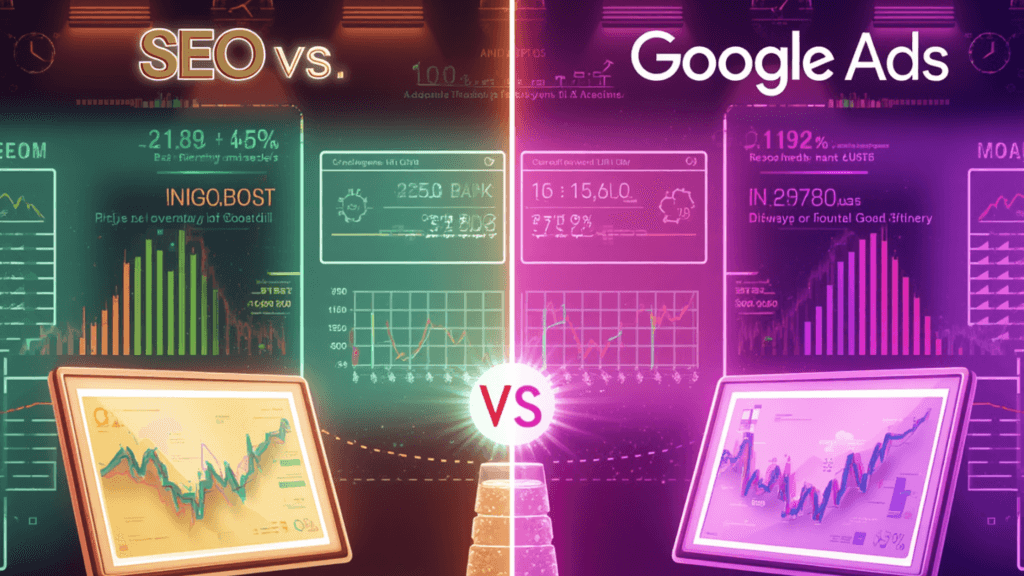
The fundamental difference: SEO is slow and compound. Google Ads is immediate and controllable.
The Core Trade-Off
| SEO | Google Ads | |
|---|---|---|
| Speed to results | 3–12 months | Immediate (hours after launch) |
| Cost structure | Agency fee + time investment | Agency fee + ongoing ad spend |
| Longevity | Compounds over time; rankings persist | Stops the moment you stop paying |
| Traffic quality | High — users trust organic results | High — user intent is strong on search |
| Control | Limited — Google’s algorithm decides | High — you control budget, targeting, messaging |
| Best for | Long-term brand building | Immediate lead/sales generation |
| ROI timeline | 6–12 months to positive ROI | Can be positive from month 1 if managed well |
When to Start with Google Ads
Google Ads is usually the right starting point if:
You need leads or sales now. A new business, a business that just lost its main marketing channel, or a business with a specific seasonal window can’t wait 6 months for SEO to kick in. Google Ads puts you on page one immediately.
You’re in a high-intent category. When someone searches “emergency plumber Manhattan” or “divorce lawyer NYC consultation,” they are ready to act. That intent makes Google Ads extremely efficient — you’re capturing demand that already exists.
You want to test what converts before investing in SEO. Google Ads data tells you exactly which search terms drive conversions on your site. This is invaluable before you invest in SEO — you’re building your SEO keyword strategy based on data, not guesswork.
Your margins can support the cost. If you sell high-ticket services (legal, finance, medical, luxury goods, B2B SaaS), the cost-per-click economics on Google Ads usually work. If you sell $20 products with 30% margins, the math is much harder.
When to Start with SEO
SEO is usually the right starting point (or the right priority) if:
You’re playing a long game and have time. If you’re building a brand that will exist for 10+ years, the compound return from SEO is extraordinary. A well-ranked page can drive traffic for years at zero marginal cost per click.
Your category is information-driven. Businesses where customers research extensively before buying — home renovation, real estate, financial planning, healthcare — benefit enormously from ranking for informational queries at the top of the funnel.
You want to build an owned asset. Google Ads traffic disappears the day you stop paying. Organic rankings are an asset you own. Business owners who understand this long-term dynamic often prioritize SEO as their foundational investment.
You’re building content authority in a niche. AI search optimization (ranking in Google AI Overviews, ChatGPT, Perplexity) is entirely SEO-driven. If you want AI tools to cite your business as an authority in your niche, SEO and content strategy are the path.
The Case for Doing Both
Most established businesses benefit from running SEO and Google Ads simultaneously — at the right ratio for their stage.
The synergy is real:
- Google Ads data identifies the highest-converting search terms → SEO targets those terms in content
- SEO builds organic traffic that reduces your dependence on ad spend over time
- Running ads while your SEO builds gives you traffic continuity
- Appearing in both paid and organic results for the same query significantly increases click-through rates and perceived credibility
A typical allocation for a growing business: start with Google Ads to generate immediate results while SEO builds over months 1–12. Gradually reduce the ad spend budget for terms where organic rankings have been established, and redirect that budget toward new target keywords.
The AI Search Dimension (2026 Update)
In 2026, the question isn’t just “SEO vs. Google Ads” — it’s also “how do I appear in AI search?”
Google AI Overviews, ChatGPT, Perplexity, and other AI tools are becoming a primary way people find businesses and make purchase decisions. This is an SEO-driven discipline: AI tools cite websites that have:
- Strong organic rankings
- Structured FAQ content with schema markup
- Clear organizational credibility signals (reviews, credentials, years in business)
- An llms.txt file telling AI crawlers what the site is about
Google Ads has no equivalent mechanism for AI search — you can’t pay to appear in ChatGPT’s recommendation. This makes SEO, and specifically AI search optimization, increasingly important for businesses that want to be found through AI tools.
Digital Drew SEM has built AI search optimization into its core SEO service — including llms.txt implementation, FAQPage schema, and content structured specifically for AI citation.
Practical Decision Framework
Start with Google Ads if:
- You need results in the next 1–3 months
- Your product/service has high margins and strong search intent
- You want to test conversion data before investing in content
Start with SEO if:
- You’re building for 12+ months out
- Your category is information-research-heavy
- You want AI tools to recommend your business
Do both if:
- You have budget for both (typically $1,500–$3,000/month for each service plus ad spend)
- You’re a growing business that needs immediate leads AND wants to build long-term organic traffic
- You want to reduce dependence on paid advertising over time
Frequently Asked Questions
What is the difference between SEO and SEM?
SEO (Search Engine Optimization) improves your website’s organic (unpaid) search rankings over time. SEM (Search Engine Marketing) refers to paid advertising on search engines, primarily Google Ads. SEO is a long-term investment that builds compounding traffic; Google Ads delivers immediate results that stop when you stop paying.
Is SEO or Google Ads better for small businesses?
It depends on timeline and budget. Small businesses with immediate revenue needs and decent margins typically see faster ROI from Google Ads. Small businesses playing a long game with limited monthly budget often find SEO more cost-effective over 12–18 months. Many small businesses benefit from starting with Google Ads to generate revenue while SEO builds, then gradually shifting budget toward organic as rankings improve.
How much does Google Ads cost for a small business in NYC?
Effective Google Ads campaigns for small NYC businesses typically require a minimum of $1,000–$2,000/month in ad spend, plus management fees. Highly competitive categories (legal, medical, financial) often require $3,000–$10,000/month in ad spend to be competitive. Digital Drew SEM offers a free consultation to assess your specific market and recommend a realistic budget.
How long does SEO take to rank on Google?
Most businesses see meaningful ranking improvements within 3–6 months of consistent SEO work. Ranking on page one for competitive terms in a major market like NYC typically takes 6–12 months. Digital Drew SEM’s data-driven approach prioritizes keywords with realistic ranking potential given your current domain authority — targeting fast wins first while building toward more competitive terms.
Can I do SEO and Google Ads at the same time?
Yes — and for most growing businesses, running both simultaneously is the optimal strategy. Google Ads provides immediate traffic while SEO builds over time. The data from Google Ads (which keywords convert best) informs SEO strategy, making both channels more effective together than either is alone.
Does Digital Drew SEM do both SEO and Google Ads?
Yes — Digital Drew SEM is a full-service agency offering both Google Ads management (as an Official Google Partner) and data-driven SEO, including AI search optimization. Many clients run both services simultaneously. Contact [email protected] for a free 30-minute consultation to discuss the right mix for your business.
Drew Blumenthal is the founder of Digital Drew SEM and author of “Digital Drew’s Playbook.” An Official Google Partner since 2017, Drew has helped hundreds of businesses grow through Google Ads and SEO in NYC and nationally.

Drew Blumenthal is the founder and CEO of Digital Drew SEM, a results-driven, performance-focused digital marketing agency based in New York. With deep expertise in Google Ads, Meta advertising, SEO, website development, and social media management, Drew combines creative strategy with analytical precision to deliver measurable growth. He frequently shares insights on performance marketing, digital trends, and scalable strategies for business growth.